
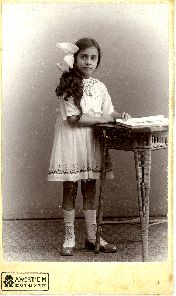
Liselotte Johanna Teophilia Wedell (aka Lilo) was born 12 Sep 1908 to Ludwig Wedell (1876-1942) and Alice Lowenberg (1881-1939).
The family resided in the Charlottenburg district of Berlin, Germany. According to family history, Alice was very close with her mother Henrietta, who lived nearby. When Lilo would walk home from school, she walked by her grandmother’s house, who would watch for her from the window.
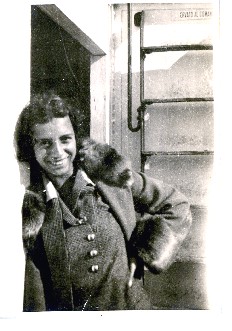
Lilo (date unknown)
Little is known about Lilo’s childhood, as she did not share many stories with her children. However, as an adult, she was known to be an excellent cook. When asked how she learned to cook, she responded that she had attended a cooking school during a forestry camp over one summer as a young adult. She also shared stories that she attended classes at the University of Berlin with an interest in pharmacology.
In the fall of 1933, Lilo met Werner Bollmann during a holiday in the German Alps. Both Lilo and Werner were nurturing romantic wounds from a breakups of previous relationships. Lilo had spent several months living with “the professor” in Italy, whom she met during a vacation with her mother. She and Werner quickly fell in love and decided to marry. However, the time period was early in the regime of the National Socialist party (Nazis). Because Werner was raised as a member of the Lutheran (Evangelische) faith and Lilo was raised Jewish, Lilo’s father granted permission for the couple to marry, provided they agree to raise any children as Christians. Not uncommon for the time, neither a priest nor rabbi would officiate a wedding ceremony. Werner and Lilo were wed in a civil ceremony on 9 May 1934.
Their first child, Heinz Paul Ludwig Bollmann (later, aka Henry or Hank), was born prematurely on 28 Dec 1934 in Berlin, Germany. The family lived at Kaiserin-Augusta Strasse 31 in the Templehof district of Berlin, Germany.
Prior to WWII, the population of Berlin was 4.34 million, yet only 160,000 persons were members of the Jewish community. While this represented less than 4% of the population, Jews in Berlin were subject to the 1935 Nuremberg Laws governing racial classification. Married to an “Aryan”, Lilo was identified as a “privileged Jew”, as defined by the 1939 Law of Tenancies. Support from “Aryan” Germans was critical to the Nazi regime, so privileged Jews were given some freedoms in the 1940’s. For example, since their son Heinz did not attend a Jewish school, neither he nor Lilo were required to wear the yellow Star of David as did many of her friends and family.
A sickly woman all her life, Lilo’s mother Alice died on 18 Feb 1939. She had thyroid issues for most of her life and most likely died from complications of and lack of medication for Grave’s disease and malnutrition resulting from Nazi policies of rationing food and basic needs to Jews.
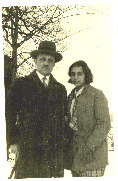
Lilo’s father perished in the Shoah in Riga, Poland (now Lithuania). Records indicate he boarded a transport train on 19 Jan 1942 and was relocated to a newly established concentration camp in Riga a few days later. Stories differ whether he died en route or in Riga, but he most likely perished before the end of the month.
During bombing raids of Berlin between 1942 and 1943, their apartment building was partially damaged. In an effort to claim relief for damages, Lilo was arrested for not having correct documentation as a Jew when she met with the Berlin authorities. During her time in prison, she gave birth to a set of twins, Goetz and Lutz, who were immediately taken from her and into Nazi custody. It is presumed the twins did not survive.
The following year, Heinz was sent to live in Braunfels with his “Aryan” grandmother Elisabeth, with the fear that the flat where they lived could be hit in a bombing raid. The family was later reunited to live in Berlin so they “could die together” if circumstances should occur.

As the Nazis sought to provide an “Aryan” union, they drafted more and more laws to constrain the Jews. Eventually, these laws were written to include Christians in “mixed” marriages. By 1938, the government eased divorce laws to allow Christians to divorce their Jewish spouses, and by 1941, the government made sexual relations with Jews a crime punishable by imprisonment. Many times during these years, Werner was given several opportunities by the government to divorce Lilo, and was later sent to work in a labor camp for his “crime.” According to family history, he was interred near an airport between Berlin and Hamburg in 1944 where the detainees were tasked with building shelters for the military. Werner and Lilo were able to communicate somewhat, and Lilo was able to send a coded message to him that a daughter, Rosemarie Elisabeth Alice (later aka Rosemary, Rosie, and Mady), was born on 24 Nov 1944.
Werner was given several liberties while interred and was able to travel to and from Berlin making deliveries and running errands the military, often seeing the family for short periods of time during the trips. One day when Rosemarie was five months old, Werner did not return to the camp and escaped. He continued to live underground for a few weeks until it was safe to return home. When he did return home, he often hid in the attic when visitors were around. By then, it would have been May 1945; Germany had surrendered, and the Nazi regime was quickly becoming dismantled.
At Lilo’s insistence, the family immigrated to the United States in 1947. To make the journey, the family first travelled to Bremen, where they stayed for a few days in a refugee camp sponsored by the International Red Cross. Sponsored by the American Joint Jewish Distribution Committee, the Bollmann family departed from Bremen, Germany on 10 Jan 1947 aboard the Marine Marlin, a ship which had been decommissioned after the war and functioned as a tourist class, carrying over 900 individuals. Lilo and Mady were able to stay in cabins, while Werner and Heinz bunked in the army quarters. While crossing the Atlantic, there was a terrible storm, but the ship arrived safely in New York City on 24 Jan 1947. The family had a few suitcases of personal belongings and $24 in American currency.
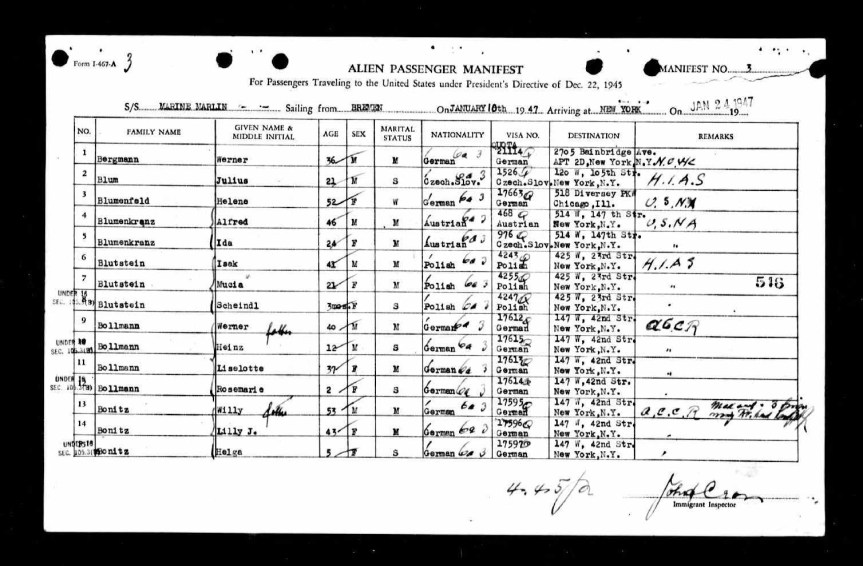
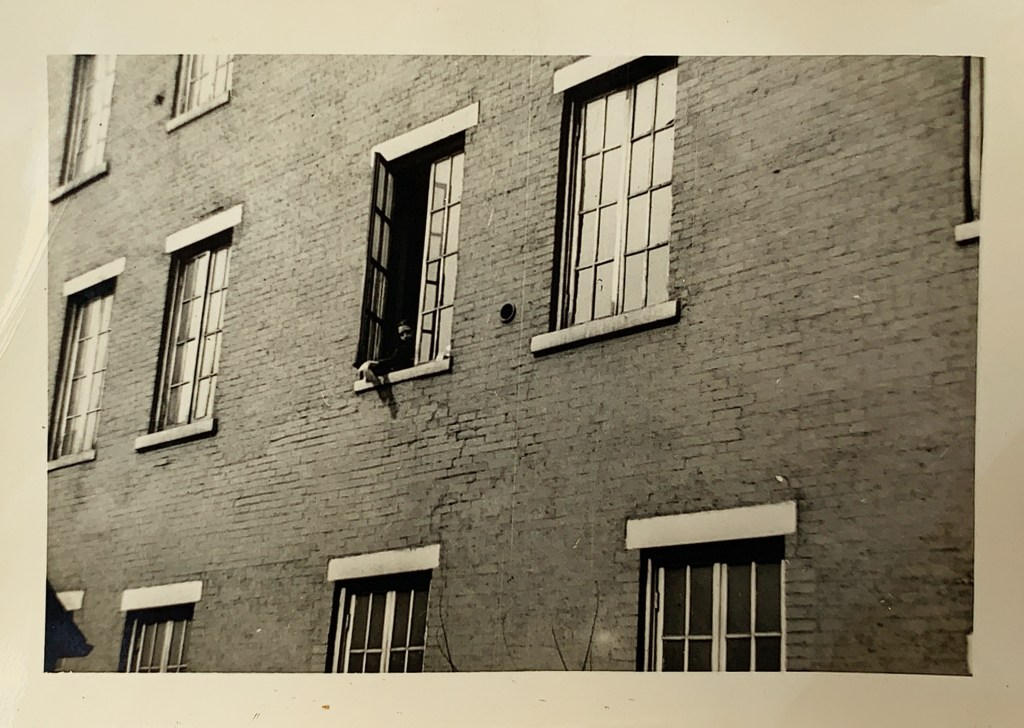
After spending a few days in New York City to visit friends and family, the Bollmanns moved to Cincinnati, Ohio, where Werner had committed to taking a job with an insurance company. They first lived in an immigrant boarding house administered by Goodwill. They later made their new home at 52 Prospect Place, Apt. 4 above a pharmacy and candy store.
Lilo originally worked doing laundry and cooking while living in the boarding house, then she would work occasionally as a waitress in the Shillito’s Tea Room and the Jewish Bake Shop.
In 1949, the family moved to 6230 Berauer Road in Cincinnati.

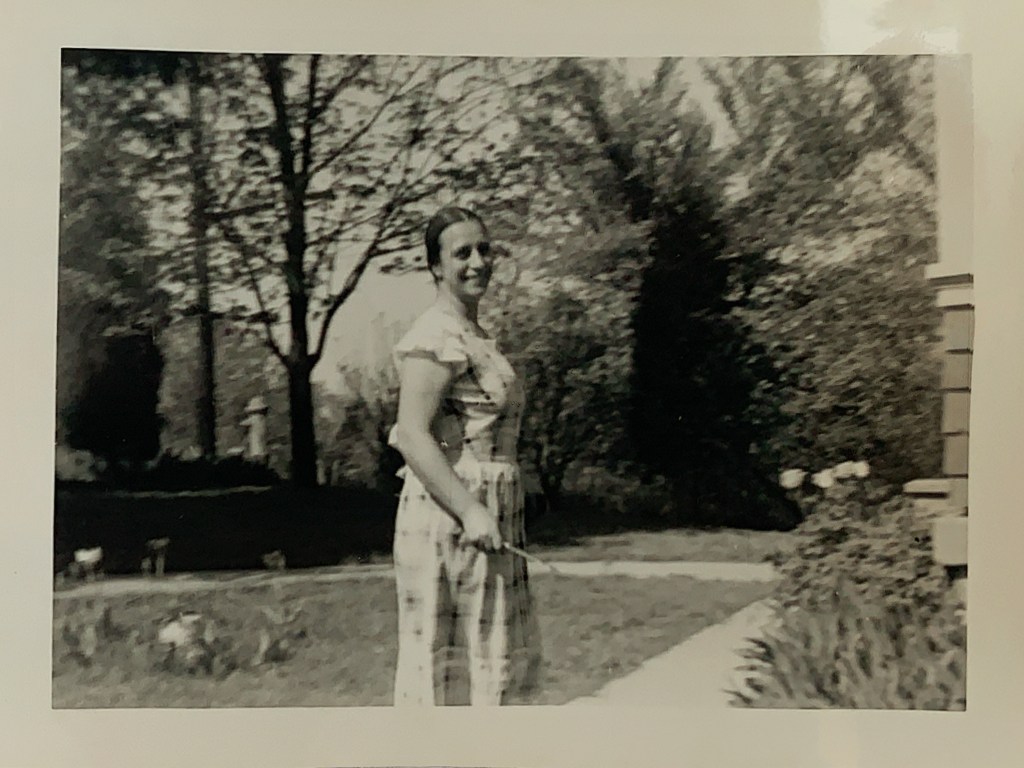
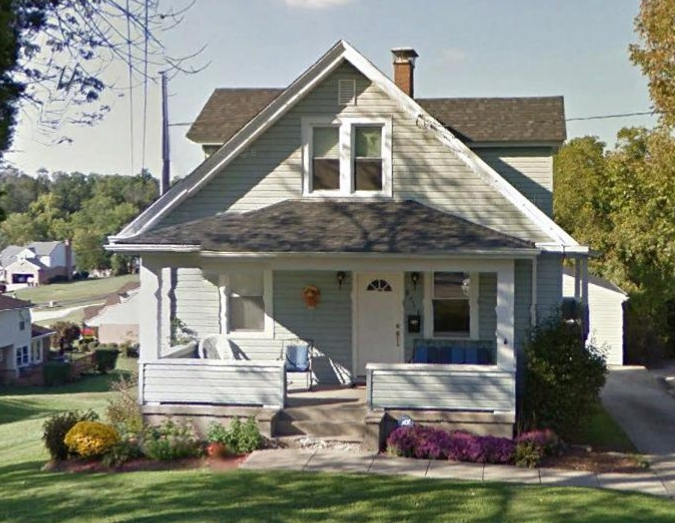

Lilo at the Berauer Road house, circa 1950’s.
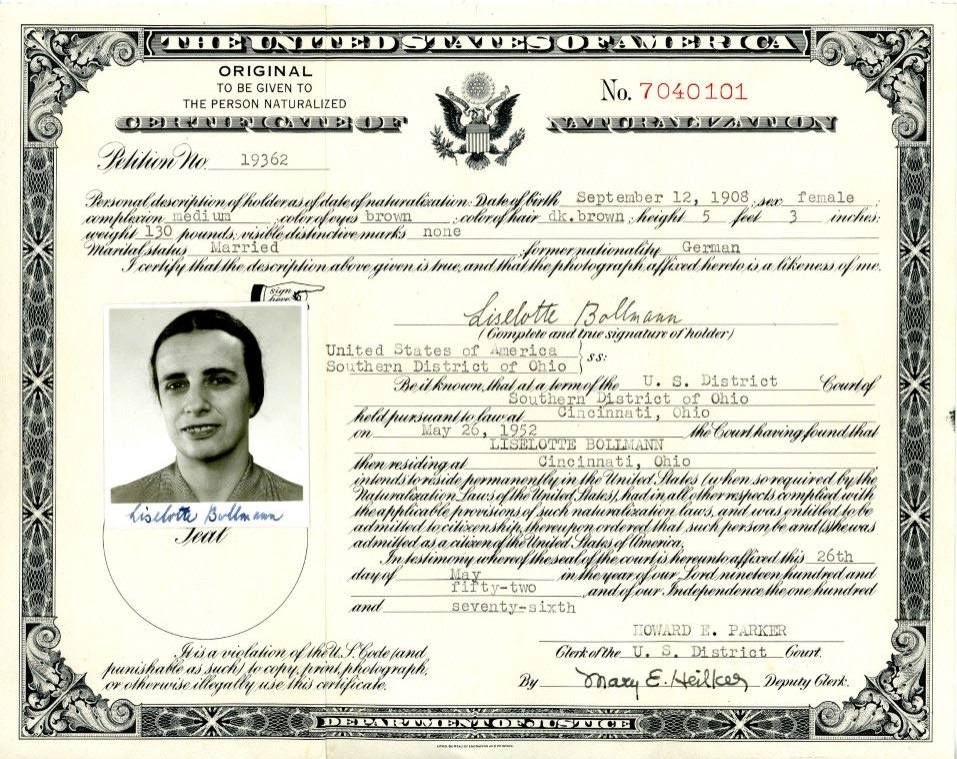
Lilo and the family became naturalized citizens of the United States on 26 May 1952. Lilo’s certificate of naturalization describers her as having medium complexion, brown eyes, dark brown hair, and standing 5’3” tall, and weighing 130 pounds.
In 1958, the family moved to 5912 Fairhill Drive, also in Cincinnati, where they had built a new home.
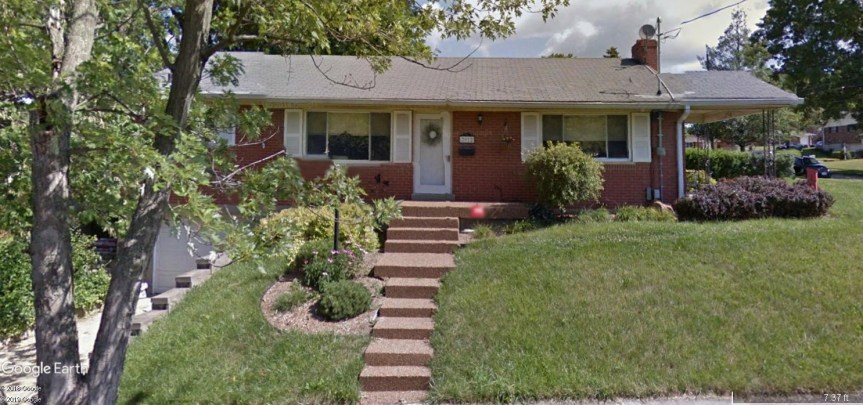
Werner died 6 Sep 1966 from a heart attack. He is buried in Spring Grove Cemetery in Cincinnati, Ohio.
After Werner died, Lilo continued to live on Fairhill Drive and became active in the local German-American society. Very outgoing and sociable, she enjoyed frequent trips to Germany and Switzerland, and volunteered at the local hospital in the pharmacy department. During her lifetime, she tried several times to convert to Christianity but was never able to deny her Jewish faith.

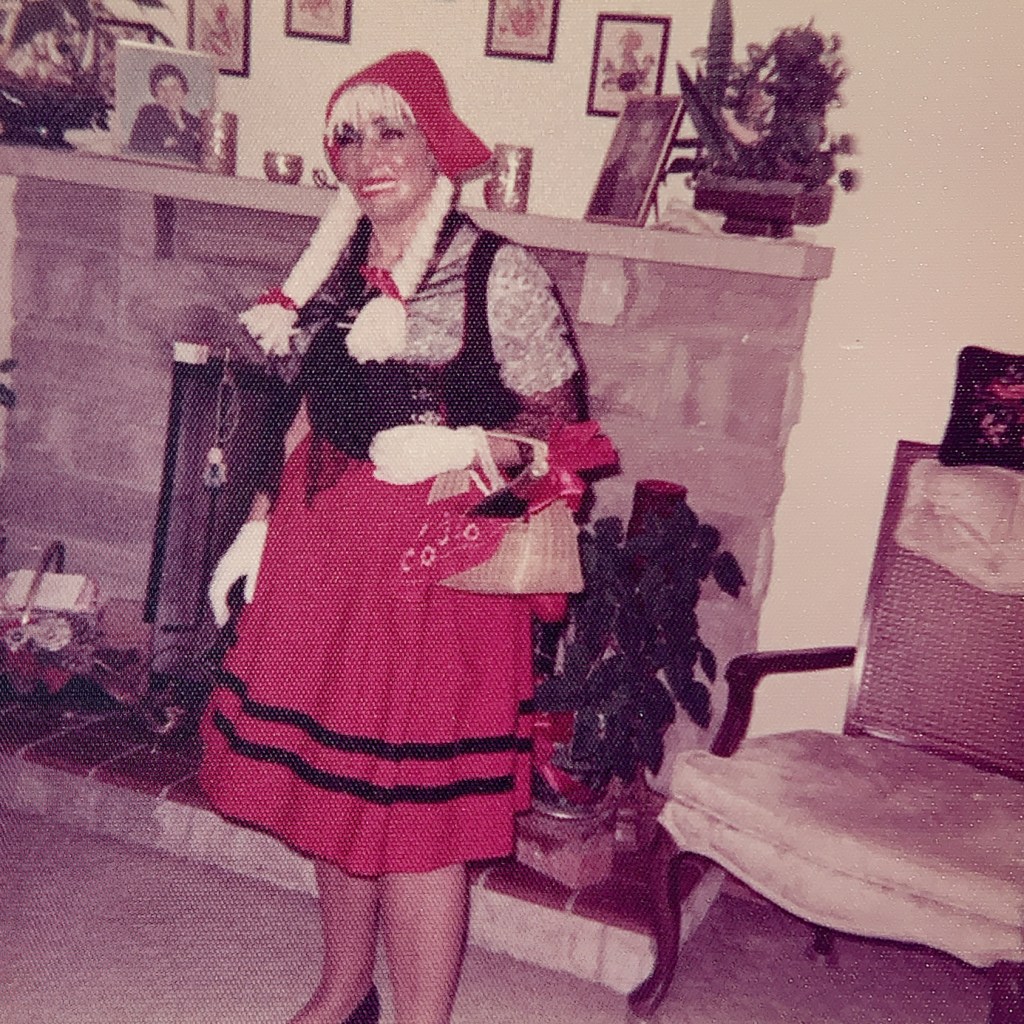

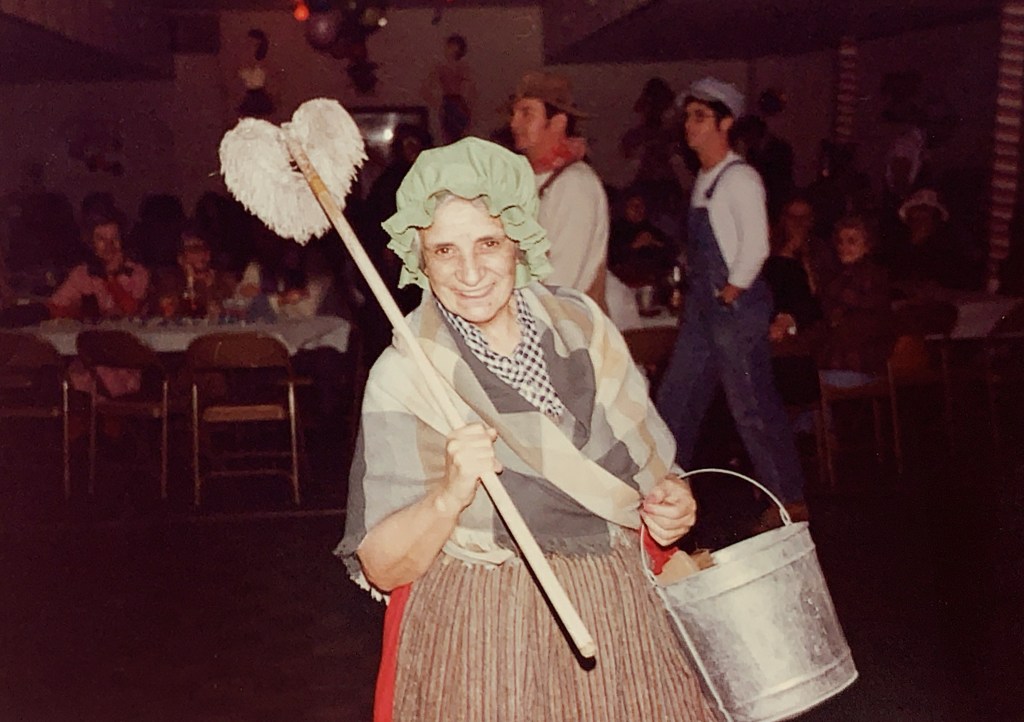
Lilo in various costumes for Germania Society parties.
She never learned to drive a car, frequently walking a mile for public transportation. Some of her favorite shopping destinations included Talbots and Herchedes Jewelers. Family members recall her sticking with many “old world” traditions, including shopping for fruits and vegetables at Findlay Market, fresh bread at Stolle’s, and many other local markets.
Lilo’s son Henry married Cynthelia Jane Love (b. 1938) and they have one child, Bradford Paul Bollmann (b. 1967).
Lilo’s daughter Rosie married Roger Leslie Church III (b. 1943) and they have two daughters, Dorene Marie Church (b. 1968) and Deborah Elizabeth Church (b. 1971).
Lilo died 9 Dec 1993 after bouts with breast and bone cancer. She is buried next to her husband Werner in Spring Grove Cemetery, Cincinnati, Ohio.
List of Sources
- Ancestry.com. German Phone Directories, 1915-1981 (database on-line). Provo, UT, USA: Ancestry.com Operations, Inc., 2015.
- Ancestry.com, New York Passenger Lists, 1820-1947 (database online). 1947, Microfilm serial: T715; Microfilm roll: T715_7269; line 1. Provo, UT, USA, accessed 27 Apr 2010.
- Ancestry.com. U.S. City Directories, 1822-1995 (database online). 1948.
- https://blogs.timesofisrael.com/privileged-jews-did-the-nazis-care-so-much/?, accessed 12 Aug 2019.
- The Central Database of Shoah Victims’ Names, www.yadvashem.org, accessed 25 July 2010.
- Certificate of Naturalization, Family Collection.
- Family histories, as told by Henry Bollmann and Rosemary Church.
- German Phone Directories, 1915-1981, 293; digital images, Ancestry.com (www.ancestry.com: accessed 4 Jul 2019). Recorded date 4 July 2019.
- Ohio Death Index, 1908-1932, 1938-1944, and 1958-2007,” database, FamilySearch.org, accessed 29 Sep 2019.
- Spring Grove Cemetery, www.springgrove.org, accessed 12 Oct 2012.
- “United States Social Security Death Index,” database, FamilySearch.org, accessed 29 Sep 2019.
- http://www.berlinjewish.com/jewish-community, accessed 12 Aug 2019.
- http://www.holocaustresearchproject.org/nazioccupation/berlin.html, accessed 12 Aug 2019.
 The Budding Genealogist