This holiday season, give the gift of heritage and discovery with a DNA test kit that unravels the secrets of your family tree. With a DNA test kit, a beginner genealogist can begin a fascinating journey, uncovering hidden stories, long-lost relatives, and rich cultural traditions. It’s not just a present; it’s a doorway to understanding who we are and where we come from, making it a truly meaningful and unforgettable gift for the holiday season. Each DNA service has its unique strengths, but Ancestry has the largest pool of participants and will continue to grow. As technology evolves, your giftee will find new opportunities to identify commonalities of his or her personal heritage.
Quite often, we’re so busy interviewing parents and extended family, that we forget to document our own personal story for future generations. With The Story of My Life, you create the story you want handed down to your children and grandchildren. Each section contains prompts to preserve your memories of your parents, siblings, childhood and more. Capture key moments of your life for future generations to enjoy.
Unlock the power of older text and documents when you can more easily read them using this lighted magnifier. This handy tool comes with a storage bag and 4 LED light bulbs and can magnify texts on maps, newspapers and other small texts 15x the original.
Keep all your precious family documents safe with this travel document bag. Perfect for packing documents and heirlooms to share with distant relatives on your research trips. Water resistant and fireproof, this 14.2″ x 10.6″ x 4″ document case includes a zipper and a combination lock for safe keeping. Be sure to use acid free envelopes to protect your individual documents.
Show off your knowledge of history with this Chronology game of all time! Suitable for 2 to 8 players, ages 14+, teach others (or learn for yourself) what happened when with common knowledge and odd bits of history.
Discover the history of America, as told through the evolution of maps. See what stories you find as you trace your ancestor through geography, as the stories of maps and engravings change the perspectives of the time. View history through the prisms of exploration, wars, and even map-making art.
Start documenting your family history with this robust software. Import your GEDCOM tree from Ancestry, Family Search or other online platform to begin adding information beyond the scope of free websites. Legacy Family Tree includes a source writer to easily document your research, multiple views and charts, and a research guidance tool to assist with those brick walls!
Help your family researcher take his/her skills to the next level with a membership in the National Genealogical Society. Each membership includes three monthly/quarterly magazine subscriptions, free family history skills courses and members only resources.
Membership in Your Local Genealogical Society
Support the efforts of the genealogical society where you live or where you are researching. Often run by volunteers, these groups can often provide local insight not easily found through general online resources.
Genealogy, the art of tracing one’s family history, has become a popular and accessible pursuit thanks to the wealth of resources available in libraries across the United States. Whether you’re a novice or an experienced researcher, the right library can significantly enhance your genealogical journey. In this blog post, we will explore five of the best libraries for genealogy research in the USA.
1. Library of Congress – Washington, D.C., USA
The Library of Congress in Washington, D.C., stands as the largest library in the world and offers an exceptional array of genealogical resources. Their collections include census records, military records, newspapers, and manuscripts, making it an indispensable hub for anyone researching American ancestry. The Local History and Genealogy Reading Room is a haven for researchers, providing access to extensive family histories and local publications. Be prepared with walking shoes, as many research rooms are scattered between buildings. And leave your computer at home! A pen and paper are much easier to carry.
2. Allen County Public Library – Fort Wayne, Indiana, USA
The Allen County Public Library, located in Fort Wayne, Indiana, boasts one of the most extensive genealogy collections in the United States. Their Genealogy Center houses a vast array of resources, including family histories, local histories, manuscripts, and microfilms. Researchers benefit from online databases and interlibrary loan services, making it a vital resource for genealogists worldwide.
3. Family History Library – Salt Lake City, Utah, USA
The Family History Library in Salt Lake City, Utah, is operated by The Church of Jesus Christ of Latter-day Saints and is renowned for its comprehensive genealogical collections. With millions of rolls of microfilm, microfiche, books, and digital resources, this library is a mecca for genealogists researching not only U.S. ancestry but also international roots. The staff’s expertise and vast collection of records make it an essential destination for anyone delving into their family history.
4. Local Library – To the Area You’re Researching
When researching a specific region or town, accessing records from the local library in that area can yield invaluable insights. These libraries often house records related to the community’s history, including birth and marriage records, local newspapers, and historical photographs. The local librarians can offer vast knowledge to their area and may be able to assist with locating cemeteries and other points of interest for the family you are researching.
5. Your Own Local Library
Never underestimate the value of your local library when it comes to genealogy research. Local libraries in various cities and towns across the USA hold unique collections, such as city directories, maps, and oral histories. Librarians often possess in-depth knowledge of local resources and can guide you effectively. Visiting your local library not only supports your research but also strengthens the bond between the community and its rich heritage.
Remember, while these libraries provide excellent resources, the expertise of the librarians and archivists is equally valuable. Don’t hesitate to ask questions and seek guidance during your research. By utilizing these libraries and their knowledgeable staff, you’ll be well on your way to uncovering your family’s unique story and understanding the intricate tapestry of your roots. Happy researching!
In today’s fast-paced world, discovering our roots and understanding our ancestry has become more accessible than ever, thanks to technology. Ancestry.com, the world’s largest online genealogy platform, empowers people to explore their family history, connect with distant relatives, and unearth fascinating stories from the past.
What are the 9 Best Tips for Using Ancestry.com?
Successfully uncovering your family history involves a blend of traditional research techniques and leveraging the platform’s advanced features. It’s about sifting through countless records, connecting the dots between generations, and preserving the richness of family narratives. Patience is a virtue, but so is persistence; both are invaluable when it comes to unearthing the past.
To make the most out of your Ancestry.com experience, here are nine invaluable tips to guide you on your genealogical journey.
1. Begin with What You Know:
Start your journey by gathering information from your immediate family. Speak with parents, grandparents, aunts, and uncles. Document names, birthdates, places of birth, and any memorable anecdotes. This foundation will help you build your family tree on Ancestry.
2. Organize Your Research:
Stay organized by creating a system for your research. Ancestry allows you to add photos, documents, and notes to individuals in your tree. Utilize these features to keep track of your findings and sources. Consistent and organized data management is key to a successful genealogical search.
3. Explore Ancestry’s Extensive Records:
When you search Ancestry, you’ll find vast collection of records, including census data, birth and marriage certificates, military records, and immigration documents. Take advantage of these resources to uncover critical details about your ancestors. Use filters and keywords to narrow down your search and find relevant records efficiently.
4. Collaborate and Connect:
Genealogy is often a collaborative effort. Connect with other Ancestry users who might be researching the same surnames or regions. Sharing information and insights can lead to exciting discoveries and help you break through brick walls in your research.
5. Verify Your Sources:
While Ancestry’s records are extensive, it’s essential to verify the information you find. Cross-reference details with multiple sources to ensure accuracy. Misattributed or misinterpreted data can lead your research in the wrong direction.
6. Preserve Family Stories:
Beyond names and dates, family stories enrich your genealogical research. Interview relatives to collect anecdotes, traditions, and personal experiences. These stories provide context to your family history and create a more vivid picture of your ancestors’ lives.
7. Take Advantage of DNA Testing:
Ancestry offers DNA testing services that can provide insights into your ethnic origins and help you connect with living relatives. By combining traditional research with DNA analysis, you might discover relatives you never knew existed and uncover branches of your family tree that were previously hidden.
8. Educate Yourself:
Genealogy is a constantly evolving field. Stay updated with the latest research methods, tools, and historical context. Ancestry offers online tutorials, webinars, and a vibrant community where you can learn from experts and fellow enthusiasts.
9. Be Patient and Persistent:
Genealogical research takes time and patience. Some branches of your family tree might be easier to trace than others. Don’t be discouraged by dead ends or gaps in your research. Stay persistent, and be prepared for unexpected twists and turns in your journey.
In conclusion, Ancestry is a powerful tool that can help you uncover the mysteries of your family’s past. By starting with what you know, staying organized, exploring records, collaborating with others, verifying your sources, preserving family stories, embracing DNA testing, educating yourself, and being patient and persistent, you can make the most out of your Ancestry experience and embark on a fulfilling genealogical adventure. Happy exploring!
“Mommy, Daddy, please can I go?” Rosemary hoped her cries would distract everyone from the untouched liver and onions on her dinner plate. Werner looked kindly and lovingly at his princess. Lilo took a deep breath and began to scold her unruly daughter. Henry desperately willed the conversation to end so he could escape to grab a cigarette.
In 1955, the Bollmann family had been living in the United States for 8 years. Werner was planning his first trip back to Germany to visit his mother and to celebrate her 79th birthday. It would be an expensive endeavor. The family had worked very hard for the past ten years, especially Werner, who worked nights in a tool and die shop for Fisher Body.
Werner was uncertain what a trip to Germany would mean. Although he wasn’t the rebel of his family (that honor would be saved for his brother Paul), he was in the awkward position of having married Jew during the 1930s , while his brothers became members of the National Socialist party. He would rather forget life in Berlin during the war, and the Bollmanns were comfortable now with their life in Cincinnati, Ohio.
It had been his wife Lilo who encouraged him to make the trip to visit his mother. She herself did not care for her mother in law – the disdain for the daughter in law was mutual – but Lilo was a firm believer in family. “You need to see your mother again,” she had admonished a few months earlier.
Now, here was Rosemary, or Mady as she was affectionately known to the family, begging to go along. And Werner always wanted to make his princess happy.
“Alle anderen haben eine Grossmutter,” the little girl begged. All the others have a grandmother.
Lilo, who had grown up a princess in her own father’s eyes, was not happy to compete with Rosemary for Werner’s affections. While she had encouraged Werner’s travels, those of her daughter’s were a different story. The additional travel costs were not a welcome expense.
Henry also did not have fond feelings for his grandmother. As a child, he had been sent to live with her briefly during the war while Berlin was under attack. But as the son of a “mixed race” couple, he was a “Mischlinge”, a half-breed. And he was referred to as her “Jewish grandson” and taunted more in the German countryside than he had been in cosmopolitan Berlin. Where was that cigarette?
But Rosemary knew no family other than the three around the table. No aunts, no cousins, and certainly no grandmother or grandfather, as she was barely two years old when the family emigrated to America.
“Mutti, Fatti, bitte kann Ich gehen? Ich mochte meine Grossmutter treffen,” she begged. I want to meet my grandmother.
Choking down tears, she fought over every bite on her plate. Dinner always held so much drama, thought Henry, especially when Mady was served liver and creamed spinach for her anemia. No wonder he smoked.
There was more drama afterward as Lilo cleared the dishes. Lilo was accustomed to having her way. After all, she was the one who insisted they move to the United States, even though Werner was a partner in a booming reclamation business in the months after the war. They could barely afford for Werner to travel, let alone for Mady to accompany him.
But Mady was right, Werner rationalized. She should have the opportunity to meet her grandparent. And when would another chance present itself?
Frustrated by the dinner conversation and upset with the constant diet of liver and onions, Mady cried in her room. It wasn’t easy being the child of immigrants. At school, she was too German to be completely accepted. And at home, she was too American for a family trying to hold onto their heritage and their traditions. Especially her mother’s.
Eventually, Werner overruled Lilo’s resistance and agreed Mady should travel to Germany to meet her grandmother. They would go in August, before the school year started.
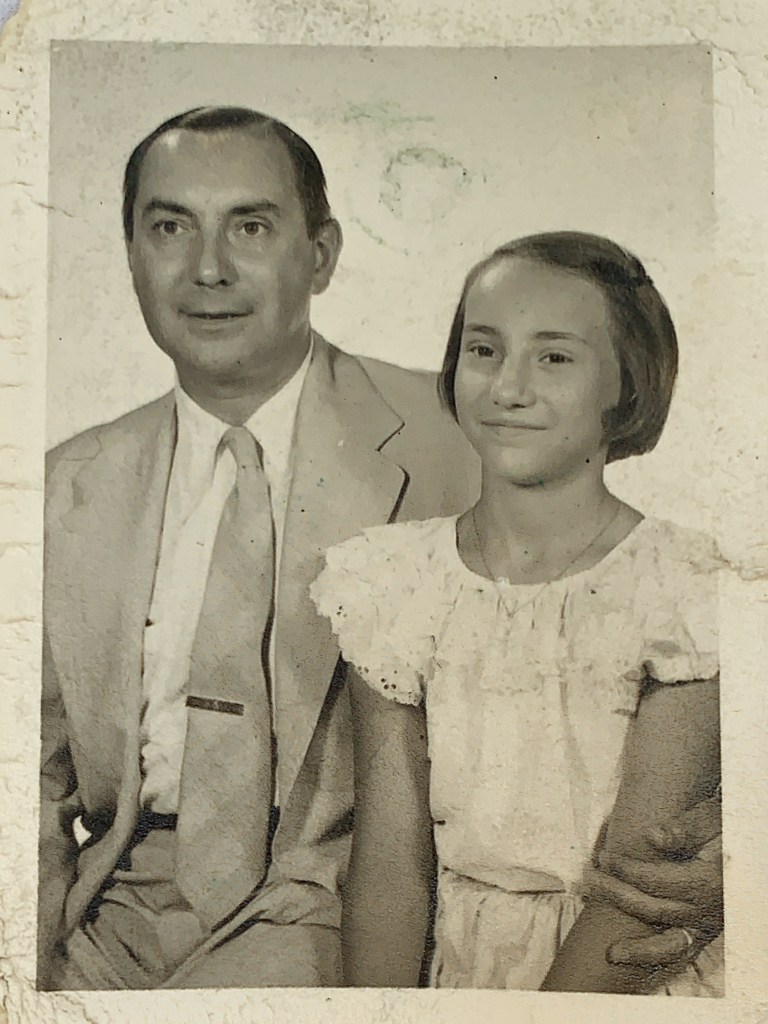
Passport photo of Werner and Rosemarie (Mady) Bollmann, 1957
Airplanes did not fly non-stop routes. Flight plans took them from Cincinnati, to New York City, to Newfoundland, to Ireland, to Amsterdam, and then to Frankfurt. After landing in Frankfurt, Werner’s nephew-in-law Hans Albert picked them up from the airport and drove them to Braunfels, a small village in western Germany.
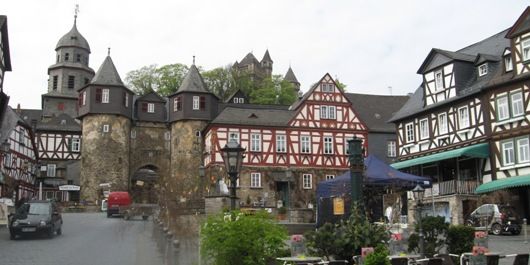
Braunfels was a quintessential German village. A spa town of roughly 10,000 (estimated population, 2020), Braunfels is situated at the foot of Braunfels Castle and features quaint Alpine architecture and cobblestone streets. Mady and Werner stayed at the Schlosshotel, where she remembers eating the best strawberry preserves on muffin bread for breakfast every morning.
Braunfels, Germany, circa 2018
Mady carried an orchid to meet her Oma. Elisabeth was kind, but not necessarily warm as Mady had anticipated a grandmother to be. Werner was all smiles as he brightened to introduce his daughter to his mother. It was good to see her again.
Living with Elisabeth was Tante Luise, the wife of Werner’s older brother Paul. Although Luise and Paul were separated, Luise had moved in with her mother-in-law as a caretaker. Mady recalled Luise walked with a cane due to a “bum” leg. According to family stories, her knee cap had been broken from being harassed and assaulted, punishment for being married to a Nazi.
Oma Elisabeth, it turned out, was as strong willed as her own mother. And very German, meaning not as affectionate as Mady had hoped. She often clung to her grandmother, hoping to be doted upon with affection.
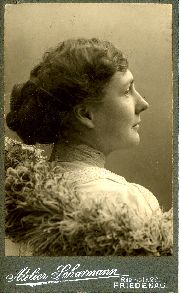
Elisabeth Castendyck Bollmann, date unknown
They celebrated Elisabeth’s birthday with her favorite dinner, eel. Considered a delicacy in Germany, this was a strange meal to Mady, although she was accustomed to a variety of food. (Lilo was a fine chef and often prepared meals such as lung hash and beef tongue.) Joining the family were Luise’s daughter Inge, son-in-law Hans Albert, and grandson Axel (age 3). Inge doted upon her uncle and little niece, the only members of her extended family.
Mady recalls going for afternoon walks with her grandmother around the village and being fascinated how the woman was greeted as “Frau Oberst” (Madame Colonel). Werner’s father had been mortally wounded in WWI, and it was customary for a woman to be recognized with the title of her husband. After their walks, Oma would snack on tomatoes in a sugar bowl, before retiring to her bedroom for a nap. Mady would sit by her feet while she snacked, getting as close as she could, then play quietly. Since Werner worked nights, quiet play was not an uncommon skill.
One day, Hans Albert took Werner and Mady on a tour of the nearby town Gessen. Driving through town, Hans Albert suddenly stopped the car and said, “Das ist Paul.”
Paul, Werner’s estranged and only living brother, and Werner had not seen each other in over ten years and were not inclined to have a friendly dialogue. Paul was six years older and had graduated from the Prussian Military Academy. Following in their father’s footsteps, Paul joined the German Army during the war. And he became a strong supporter of the National Socialist party. He was a former Nazi.
But Paul was also the black sheep of the family. He wasn’t smart or ambitious like his older brother Fritz, nor was he the amiable favorite like his younger brother Werner. When the Second World War ended, Paul was interred in a POW camp in Italy after being captured in northern Africa. Upon his release, he was rumored to have stayed in Italy for some time with a mistress, while his wife lived with and cared for his mother.
Werner, always amiable, took Mady’s hand and crossed the street to meet Paul. After a few brief sentences, Paul looked down and said, “Ist sie dast kleine Madchen?” Is that the little girl. Werner said yes, and introduced his daughter to his brother. After a few more coolly stated sentences, the brothers parted ways.
Mady and Werner stayed in Braunfels nearly two weeks. Werner wanted to go to Charlottenburg, a suburb of Berlin, to visit his father’s grave. But Mady was too afraid to travel to Berlin, for fear the Russians would kidnap them.
Soon, Werner and Mady returned home on a flight similar to what brought them over.
Six weeks later, Oma Elisabeth fell and broke her hip. She died of pneumonia a few days later.
But it was January. And while Bremen is further north than New York City, the route through the Atlantic Ocean was colder due to easterly currents from the Gulf Stream and the voyage was taking place during the worst months for such trip.
Helga Bonitz and Heinz Bollmann aboard the Marine Marlin, January 1947.
Other passengers included Dr. Kagys Grinius, president of the Lithuanian Republic rescued from a Displaced Persons camp, and Hannah Unger, an orphan who would be provided for by Albert Einstein.
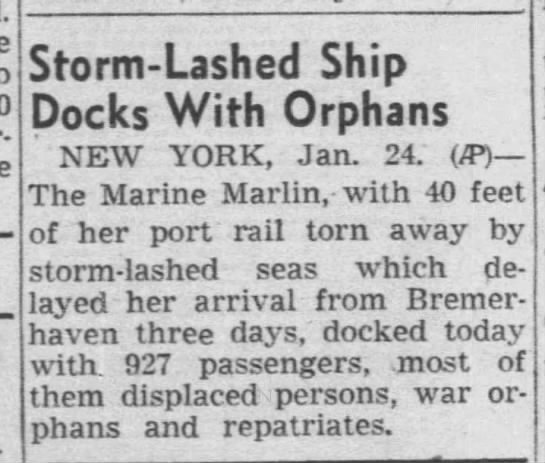
According to accounts from many passengers, the bow of the ship was severely damaged during a storm, and many feared the ship would sink before the voyage was complete. In his journal, Werner wrote, “The heavy breaking waves that entered the vessel over the stern heavily damaged roughly 8-10 meters of the Süllboard. You can’t possibly imagine how powerful the sea water is, and all portraits of the sea – the so-called ‘seascapes’— are just a primitive reflection of this rather grandiose reality. It is magical to witness the power of the elements, however, I must admit that even I desire to see an image of calmer waters.”
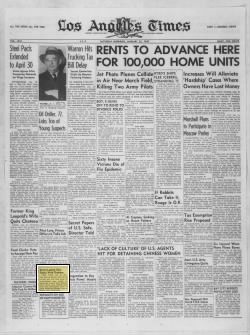
News of the ship’s arrival, as reported in the Los Angeles Times, 25 Jan 1947.
Following are additional excerpts from Werner’s journal:
“Today, as I am writing these notes, we have been on our journey for ten days. And not one of those days has been calm, with the exception of the first few hours on the Channel. You always have to progress hand over hand through the hallways and up the steps, and sometimes you have to even wait until the ship has moved back up into an upright position, so that you can have solid ground beneath your feet. Yesterday, [the heavy seas] prevented us from eating on deck, and they were unable to serve lunch. Since many dishes had been broken due to the heavy seas, they ended up serving some goulash with no sides on tiny paper plates. The kitchen was unable to really cook anything. Even the bread – I was able to talk to the ship baker – fell out of the oven. Due to the bad weather our trip will be delayed by at least five days! And the weather is also not very likely to change any time soon. As I went to send off a radiogram to New York City, I happened to talk to one of the ship officers. I learned from talking to him that the bad weather is dominating an area of at least two thousand square miles. We have changed course frequently in order to enter areas with better conditions, to no avail. It is the same everywhere. So, we can anticipate a continued roller coaster ride until the end of our trip. The officer said that January through March tended to be the worst months of the year for travel. When I go down to our sleeping rooms, it looks like after an alarm. All suitcases lay wildly scattered around between broken piece of glass and bottles. The dining room chairs are falling over like tin soldiers, and it has even happened that some passengers have sustained injuries, and somebody even fractured a bone. All of us are doing fine, thanks to god.
“It was horrendous, the absolutely worst time to cross the Atlantic. We, the passengers out of a hellish time were thrilled to be chosen all the same. As a small child, literally, just 7yrs. I remember the ship pitching and rolling, making it extremely difficult to avoid being thrown around. The stormy seas, crashing waves across the deck and top of the ship were frightening. I either recall or was told that life boats were to be readied. Long tables and benches were the way I recalled the Dining Area. Very few overcame extreme seasickness during the long harshest portion of the voyage. My Dad, like your grandfather endured severe food deprivation. Somehow his overwhelming need for fats led him to eat butter with a spoon, turning the few remaining diner’s stomachs to rebel. My Mom, Lilly, was seasick. She and I were in the woman’s area, sleeping on stacked cots perhaps 3 high. She, took the top bunk so I wouldn’t be thrown out by the motion of the wild sea. She did, resulting in a severe head injury that almost cost her a chance to enter the US during our evaluation on Ellis Island.”
Helga Bonitz
Werner continued, “Rosemarie gets really upset every time that people have to hold on tight to tables and chairs until finally everyone is tumbling around any way. So most of the times she stays in her cabin on her bed. By the way, yesterday our crib broke because it was thrown back and forth so heavily. We moved the crib outside, so we could have more space in the cabin. Already in Bremen Madi complained about her ‘Baumi’, her left thumb. It was swollen pretty badly, all red, and it looked pretty bad. We’d hoped that it would get better soon. Unfortunately, it was getting so bad that she had to go to the ship hospital once we were on board. Her thumb was badly infected, discharging pus, and she was also developing a high fever. We were afraid that she might have come down with the measles since her entire body was so red. After the doctor cut and drained the wound and after she saw the doctor on a daily basis to inspect the wound and change the bandage, her fever went down. Yesterday, they removed her bandage and her ‘Baumi is Heile Heile [Editor: This is an idiomatic German saying, perhaps similar to the English saying, ‘Let Mamie kiss my owie—make it feel better’]. This episode was a pretty scary warning shot for us. The doctor, a lovely man, treated her really well, and she made friends with him. Every time she sees him even from a distance, she calls him. Sadly, he doesn’t understand a single word of German, so the conversation is always a little funny.
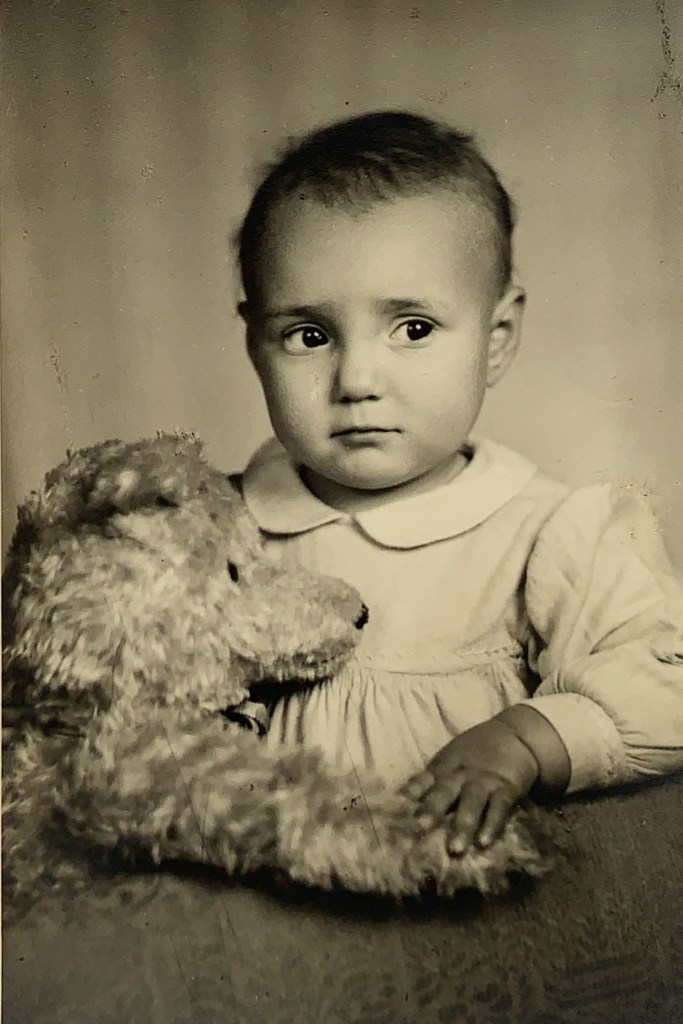
Rosemarie Bollmann, Fall 1947
“The quality of food served on board has gotten much worse, and the food is absolutely monotonous. Almost every day, we are getting exactly the same food, and it’s often not very good at all. We hardly receive any fruit because the stewards are distributing it under the table among those that are on good terms with them, for example the so-called ‘pretty girls.’ In the evenings after supper, you can see those girls standing at almost every corner of the ship, eating ice cream, fruit, or even a good piece of meat (the latter of which we were served rarely). Beverages or something along those lines are not available at all. It is only in the evening hours between 7 and 8 p.m. that they offer Coca-Cola, cigarettes and chocolate at a small kiosk, however, most everything sells out quickly with the exception of cigarettes, and you have to endure getting pushed around by crowds of people if you want to get anything at all. In addition, some parts of the ship are so indescribably filthy, let alone the hard-to-ignore signs of sea sickness everywhere around us. Fortunately, our bathrooms were relatively clean – since we slept on the “C” deck – however, it almost requires special skills to use them, considering the ship’s constant motion.”
Finally, after fourteen days, the Marine Marlin arrived in New York City. Werner continued, “You can imagine the level of excitement among passengers, when the ship radio announced that we were slated to arrive in New York City (Pier 90) on January 24, probably around 3 p.m.! I almost want to say that from that point on nobody was experiencing sea sickness any more, and one could notice a sudden onset of bustling activity. Everyone started to pack, and I hardly recognized many peoples’ faces because they had decided to finally shave their beards. On the next day, in the morning of the 24th, we were supposed to be able to see land! Fortunately, the storm finally calmed down, which was probably due to the fact that we were getting closer to main land, plus we were moving through much calmer waters, with the ship leisurely bobbing up and down. Almost no one slept much this night, considering the state of pleasant anticipation for what was to come on the next day, which was going to be our very last day on this shaky platform! And right on—shortly after breakfast, which was worse than ever before, we spotted a big steam boat along with several smaller fishing boats, and most of all we were seeing land—which we had been longing to see for such a long time! The SS Marine Merlin was full of bustling activity, and the ship radio continuously made announcements related to logistics of the anticipated arrival. The young ladies – who had almost ‘died’ from sea sickness a few days prior –were now seen strolling around the decks dressed up in new and pretty dresses, as if they were already perfect Americans!”
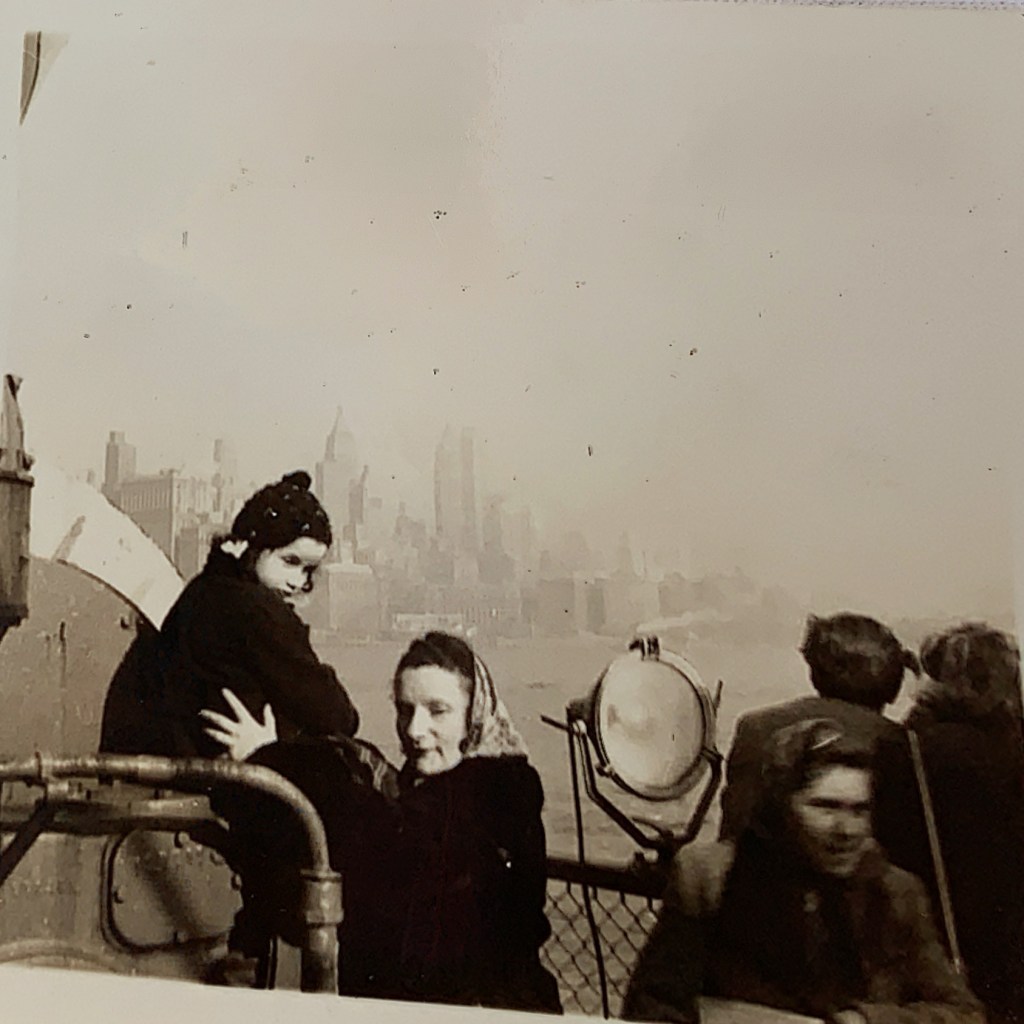
First sites of New York City. Helga and Lilly Bonitz are featured on the left.
“Like millions of other immigrants to America, I experienced the elation of seeing the Statue of Liberty looming up at the entrance of New York Harbor. After the stormy crossing of the Atlantic the skies cleared as if by magic. The ship floated over the smooth surface of a suddenly tranquil sea. It seemed as if the elements themselves became subdued by the torch lifted high, promising freedom to the oppressed masses of humanity. For me and my fellow survivors the words of Emma Lazarus — carved on the pedestal of the Statue of Liberty — were especially appropriate. Our ship indeed carried the “huddled masses yearning to breathe free.” I experienced the exultation and emotions of joy as we disembarked in Ellis Island, the gateway for millions of immigrants to America. My sufferings came to an end. The promise of the New World, at one time unattainably distant, now became a reality.”
Fellow passenger, name not recorded.
“At around noon members of the much-feared commission came on board, in order to check our paperwork and prepare us for arrival. We had been moving down the Hudson Bay for quite some time and were seeing the shore on both sides of the boat. We saw many boats—large and small— that were either moving or staying still. And wherever we looked, we saw much bustling activity and movement, a scenery which we were not used to seeing at all. By 1 p.m. we were supposed to have passed the commission’s controls, at which point we received the relevant paperwork and stamped ID cards, which were needed to get off the boat. At this point we were able to see the first sky scrapers! We passed the first couple of piers of the Manhattan peninsula, which is of course where the sky scrapers are located. However, we didn’t get to see much of it since we were tied up with processing our paperwork for about 30 minutes. Since we were among the first to go through processing, however, we were able to get back to our deck pretty quickly, to catch an impressive panoramic view of this big city. As part of the processing protocol, we received a visa as well as a landing card. Additionally, everyone received a badge that featured the name of his/her specific committee on it. Of course, we took Mädi with us to enjoy the panoramic view on deck, to take a good look all around us. All of this was so overwhelming that it is hard to describe.”
After disembarking, the Bollmanns were greeted by Lilo’s childhood friend Hilde Pinkus, who expressed relief because there had been several SOS calls from the ship during the storm. They stayed in New York City for a few days, touring the city and visiting Hilde and Lilo’s aunt Bertha Chaskel. Their voyage complete, but their journey still to continue. They would continue their travels to Cincinnati, Ohio, which would become their new home.
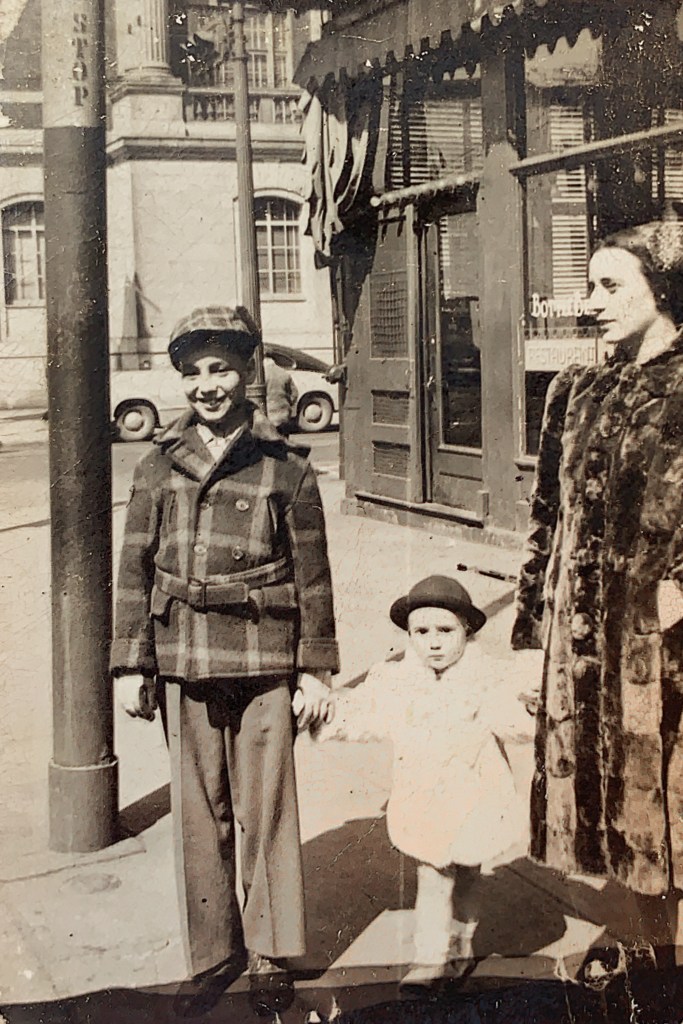
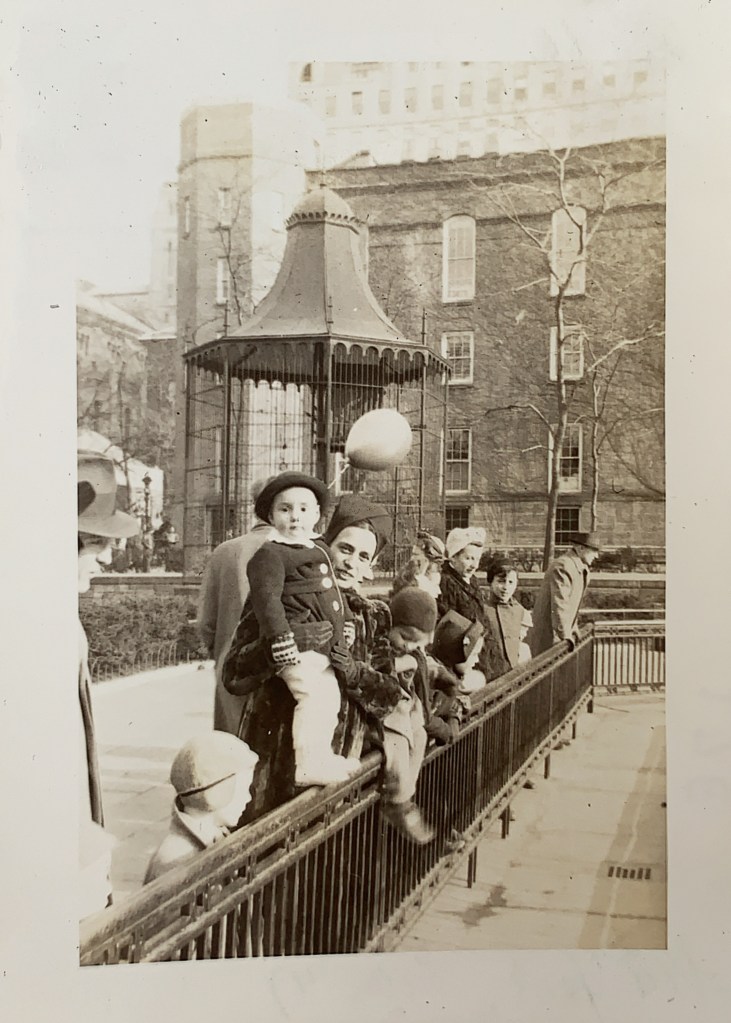
Heinz, Rosemarie and Lilo Bollmann, New York City 1947Rosemarie and Lilo Bollmann, New York City 1947
Many thanks to my colleague Daniel Sturm, for his translations of Werner’s journal.
Sources
As told by Helga (Jackie) Bonitz Zucker to Dorene Nowatzke, March 8, 2020.
Daily News, New York, New York, January 25, 1947, accessed via www.Newspapers.com on March 29, 2020.
Family history as told by Heinz (Henry) Bollmann.
Family history as told by Rosemarie (Rosemary) Bollmann Church.
Journal of Werner Bollmann, family collection.
“Leonard Lyons,” Dayton Daily News, Dayton, Ohio, accessed via www.Newspapers.com on March 29, 2020.
“Memorandum from Mr. Levine to Mr. Leavitt, Subject: Marine Marlin”, September 23, 1946, JDC Archives, www.archives.jdc.org, accessed March 29, 2020.
New York Passenger Lists 1820-1957, Online publication – Provo, UT, USA: Ancestry.com Operations, Inc., 2010.Original data – Passenger Lists of Vessels Arriving at New York, New York, 1820-1897; (National Archives Microfilm Publication M237, 675 rolls); Records of the U.S. Customs Service, www.ancestry.com.
Secrets in the Suitcase: Stories My Mother Never Told Me, Molly Greenberg, accessed via GoogleBooks on March 29, 2020.
Slavs: Victims of the Holocaust, www.Prezi.com, accessed March 29, 2020.
SS Marine Marlin, Jesse Russell and Ronald Cohn, Book on Demand, 2012, accessed via GoogleBooks on April 12, 2020.
“Storm-Lashed Ship Docks with Orphans,” The Los Angeles Times, January 25, 1947, accessed via www.Newspapers.com on March 29, 2020.
On the night of 9 Jan 1947, the Bollmann family packed their bags. They were leaving Germany the next day, emigrating to the United States to begin a new life.
The past 10 years had been a full range of emotions, always punctuated by fear. Werner and Lilo were married just one year before the Nuremberg Laws went into effect, which, if they had waited, would have prohibited Werner, a Christian, from marrying Lilo, a Jew. Times of happiness, such as the birth of their first child Heinz, were bookended by times of fear, as when they sent him to live with his Christian grandmother in Braunfels. A set of twins was lost when Lilo was imprisoned for not carrying the proper identification papers with her. Werner had been arrested by the Gestapo for not divorcing his Jewish wife and sent to a labor camp, from which he had escaped shortly before the end of the war. Lilo’s mother died from malnutrition and lack of medication, and her father perished in a concentration camp.
By 1946, life in post-war Berlin was improving, but slowly. Their daughter Rosemarie, who was born while Werner was in camp, was two years old and growing rapidly (thanks in part to her penchant for chewing ration cards). Heinz hustled potatoes from Allied soldiers, especially one named Robert who befriended the cute 11 year old. Werner had established a reclamation business with his brother Fritz, salvaging rail ties and reselling to the government. But 1946 Berlin wasn’t the same as early 1930’s Berlin, which saddened them, especially Lilo. It was time for a fresh start.
Heinz and Rosemarie Bollmann, 1946.
Lilo was insistent, a characteristic trait observed by all who knew her. This wasn’t her same home. America was the land of equality and opportunity. Werner, ever the peacemaker, began to agree.
Immigrants to America were required to be sponsored either by a friend or family member, or a sponsoring agency. The family found sponsorship through the American Christian Committee for Refugees, which provided resources for families of Jewish and Christian beliefs.
With heirloom belongings and other household items in storage, the Bollmanns arrived at a displaced persons camp in Bremen in early January 1947. By now, Heinz was 12, still cute, but a shy boy. He recalls attending a dance with his parents one evening, but sitting in a corner by himself. Another couple found him and assumed that since he was by himself, he must have been an orphan. They soon began discussing how they could adopt him when Werner and Lilo arrived to clarify the confusion.
The Bergen-Belsen Displaced Persons camp, where the Bollmann family stayed while waiting to travel to the US, was a former concentration camp where Anne Frank died.
Helga Bonitz was staying at the same camp with her family. Her father, Willy, had been interred in the same camp with Werner, also for not divorcing his Jewish wife Lilly. The Bonitz family arrived at the camp a couple of weeks earlier, and Helga remembers participating in a Christmas play.
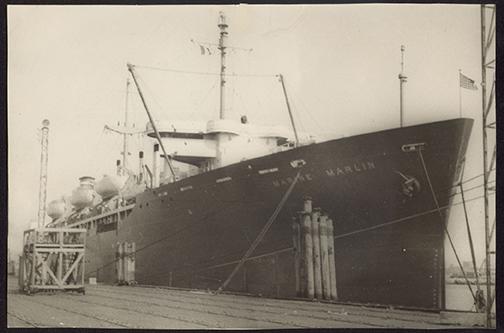
The Marine Marlin was ready for boarding on 10 Jan 1947. The ship was originally built for troop transport use during World War II, then retrofitted for passenger class after the war. As part of President Truman’s commitment to refugee aid, the ship was part of a fleet owned by US Shiplines to provide refugee transport from Europe to the United States.
SS Marine Marlin, June 1948. Photo courtesy Pier21.ca.
According to testimonies, the ship was able to hold just over 900 passengers, with men bunked in barracks style quarters on the most lower levels, and women and children living in upper level state rooms when possible. Mr. Levine (first name unknown) described conditions on a September 1946 voyage as follows:
“…this ship was overcrowded. It carried a total of 940 passengers…Almost all of our people had to sleep in dormitory type rooms in the hold of the ship. The ventilation was bad and many of the people could not sleep at night. Many of the rooms had no outside port hole. During most of the trip the ship was dirty. People complained that the rooms were seldom cleaned. For two days the sun deck was not washed and the garbage pails were overflowing with orange peels and papers all over the deck…There were about ten deck chairs for the 900 odd passengers. The people crowded on the sun deck from morning until late at night…There were no recreational supplies of any kind, except the small quantity of reading matter which the Joint supplied. Most of our people ate in the Cafeteria and many complained that the service was pretty bad. Arrangements were made for a small group to have a kosher kitchen and space was provided for them to conduct religious services…”
Letter from Mr. Levine to Mr. Leavitt, American Jewish Joint Distribution Committee, September 1946.
Spartan though the conditions may have been and braving the January cold, spirits must have been high that day for the 927 passengers as they embarked onto the ship. They were leaving war, loss of family, friends and property, and travelling to the Land of Opportunity. One passenger wrote, “We travelled on an old warship named Marine Marlin. The first day of our journey was a very happy one. We were leaving behind all our grief and sorrow. We were on our way to a new, great country, where we hoped to find a new, happy life.”
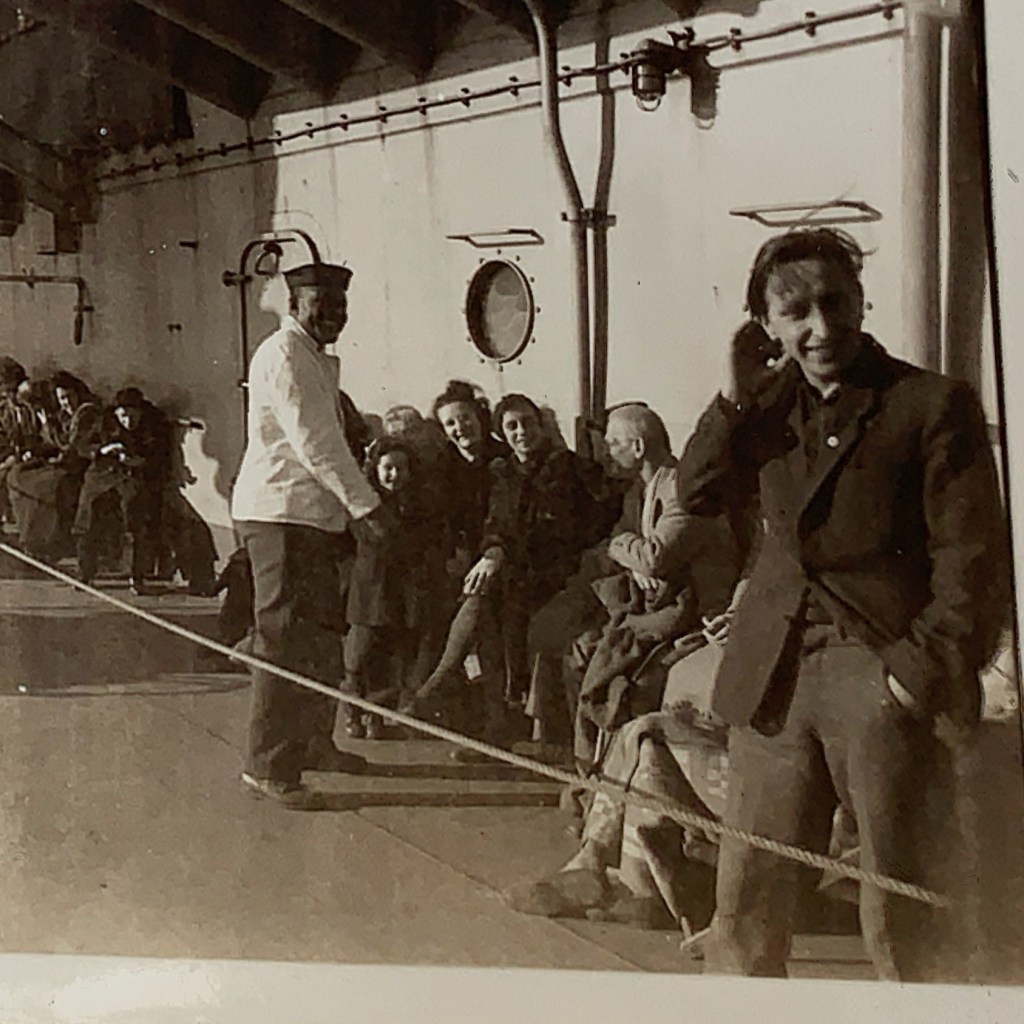
Photo aboard the Marine Marlin. Lilo is seated under the port window. Lilly and Helga Bonitz are to her left.
What’s in a name? That which we call a rose By any other name would smell as sweet.
William Shakespeare
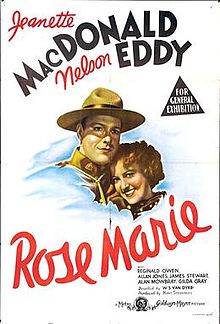
According to familly history, my great-grandfather’s favorite song was “Rose Marie”, which originated in a 1924 musical of the same name. The operetta-styled show was extremely popular, running on Broadway for 557 performances, then in London for 581 performances, before eventually being turned into a 1928 silent film starring Joan Crawford. It’s probable Ludwig was most familiar with the 1936 film version starring Nelson Eddy and Jeannette McDonald.
The song “Rose Marie” was one of the most popular from the show and film.
Why it was Ludwig’s favorite song has been lost to time. But he adored it enough that he asked Lilo to name her first daughter after the song’s heroine.
Oh Rose Marie I love you I’m always dreaming of you No matter what I do I can’t forget you Sometimes I wish that I’d never met you And yet if I should lose you T’would mean my very life to me Of all the queens that ever lived I’d choose you To rule me my Rose Marie
Lilo honored that request, naming the girl Rosemarie Elisabeth Alice. (Elisabeth was to honor Werner’s mother, and Alicie was to honor her own.) Ludwig died in 1941, not living to see his only granddaughter born.
When the Bollmann family emigrated to the United States, they were advised to Americanize at least the children’s names. After all, Heini (son Heinz’s nickname) was not really considered an appropriate name for a boy. So Heinz was renamed Henry (and later also known as Hank), and Rosemarie was renamed Rosemary. (I’ve always found it interesting that they Americanized an already American name.)
But there were other names she was called. After she was born, brother Heinz couldn’t get over why such a “little girl” had such a long name as Rosemarie. He frequently referred to her as the “Madie”, a German diminutive for Madchen, or girl. The name of Madie has carried with her as a family name, still called “Aunt Madie” by her nephew.
As time went by, Rosemary was eventually nicknamed to Rosie, the name she prefers. Today she is also known as Grandma to three loving children.
So, Rosemarie, Madie, Rosemary, Rosie or Grandma, by any other name, you’re just as sweet.
The author of this post is Dorene Marie. Dorene’s name was chosen from a book because she couldn’t leave the hospital without a name on the birth certificate. So while her first name came from a book, at least her middle name came from a song.
Today is the anniversary date of my Mimi’s (Liselotte) death. It’s fairly easy to remember – she was born on 09.12 and she died on 12.09. We were incredibly good friends, and to this day I still miss her. It would have been fun to have a mature, grown up relationship with her. So I thought today would be a good day to begin recording my favorite memories of her.
I wasn’t the oldest of her grandchildren, although my elder cousin was born only three months before me. But I suppose once I became “old enough” she began to impress upon me how much she wanted to become a great-grandmother. Why? Who knows why many of us want the things we do. Perhaps it was to see the circle of life continue. Perhaps it was because she already felt she was a “great” grandmother and simply wanted the validity of a knowing a fourth generation to make it so.
Whatever her reason, I recall her beginning to have the conversation with me when I was nineteen or so.
“Dori, make me a great-grandmother,” were her words, in the different use of the English language only she had.
“Now?!” I’d respond.
“No, you get married first.”
And so the conversation would continue. When I was twenty. When I was twenty-one. And so on. Always the same three sentences between us. One could say it was a private joke between us, although she was completely serious with her request.
Maybe her desire to become a great-grandmother was a reflection of her own mortality, although Mom says she often joked that having great-grandchildren looked better in an obituary. Certainly, she had seen her fair share of challenges and pain. I often tell the story of my mother calling to check on her well-being during a thunderstorm and tornado activity, only to learn that instead of resting on the couch in her basement, Mimi was sitting on the front porch watching the rolling clouds and hailstorm. Her comment to my mother – “Madie” (my mom’s nickname), “I’ve lived through two world wars, the Holocaust, and survived a near shipwreck to come to this country. I’m not afraid of a little storm.”
The challenges she experienced about the time I was in my late teens included breast cancer. While I’m sure the surguries and treatments took their toll, I don’t remember the diagnosis causing a scare to her. As I recall, it was relatively contained and able to be treated.
But not long after the breast cancer was remitted, the “c” word was back in our lives – this time it was bone cancer. By now she was in her early 80’s, and we could see this was it.
By now, I had married, and sure enough, became pregnant by the time I was twenty-four. Imagine five years of the “Dori, make me a great-grandmother” conversation finally concluding with a happy ending! She was so happy! For me, I think, but in all likelihood, a lot for herself.
It was a time of conflicting feelings as she slowly became more and more ill. My mom travelled to Cincinnati from our home in Muncie to take Mimi to the doctor appointments and to run errands for her. I’m sure it was especially difficult for her, watching her daughter starting a new family, while her own mother’s life was dwindling to a close.
Fortunately, in mid-February, I gave birth to a beautiful baby boy. Joseph. But somehow her German ears did not hear the name “Joseph” and she called him “Jason” for a number of days until she was finally corrected. Why Jason, I’ll never know. But I still roll my eyes with a giggle at that memory.
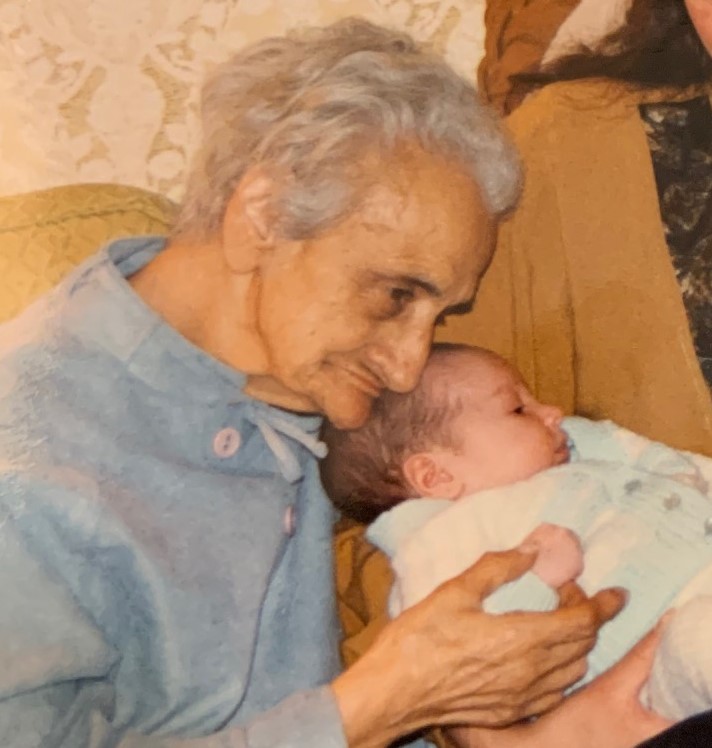
Thankfully, my Mimi was able to meet Joseph, her first great-grandchild. I remember travelling to Cincinnati just as soon as I was able so they could meet.
Whenever I think of Mimi and Joe, this is the photo which is always in my memory.
Mimi died that same year in December. While the family would eventually grow to include a total of four great-grandsons and one great-granddaughter, Joe was the only child she was able to meet and to hold.
When looking through my photos, I found this one and wanted to close in on just the two of them. How sweet.
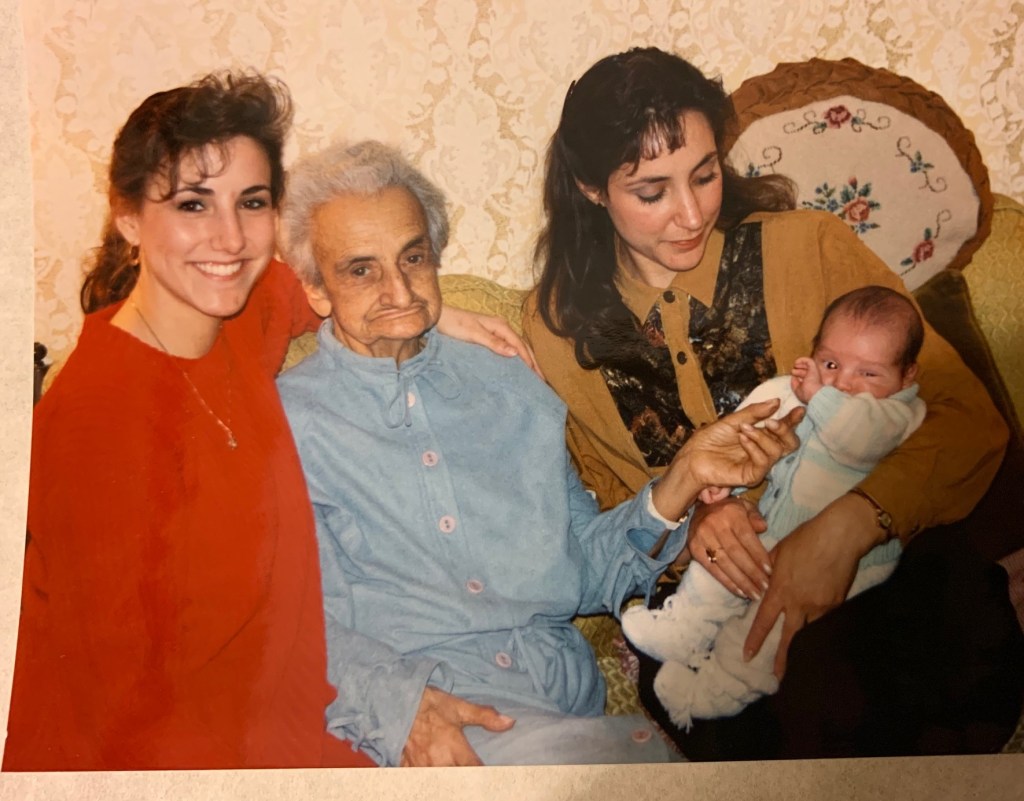
If a four generation photo exists, I’m not sure where it is. Pictured here are my sister (Debbi), Liselotte (Mimi), myself, and Joe. These photos were taken in March or April 1993.
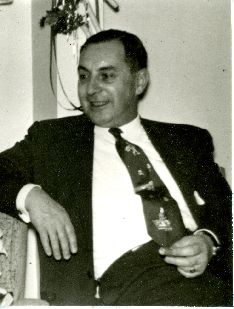
This is my Opa, known to most others as Werner Eugen Bollmann. He died before I was born. My mother was Daddy’s Little Girl. Yet while we never met, in many ways I feel like I know him from her fond memories. At least well enough that I would want to get to know him better.
I’ll fill in more details of his story at a later time. But today I want to relate part of a conversation I had with my mother.
Mom and I were discussing my Opa’s brother, Fritz, who was apparently “crazy”. Born a lefty, he had his left hand tied behind his back in an effort to force his right hand to become dominant. Such a barbaric practice! As a lefty myself, I simply cannot imagine trying to learn to use my right hand to eat or to write, but I digress. I mentioned to my mother that Uncle Fritz may have been artistic, as left handed persons are more prone to artistic traits. And if Uncle Fritz had a personality a little “out there”, perhaps this could have been the reason for his odd personality.
“Well, my dad was quite an artist,” Mom said. My ears perked up more even than they usually do during a “family” conversation.
Oh, really?
“Yes! Fatti (German for Daddy), wrote a book for my brother, which was started before he was born. It contained thoughts of welcoming a new child into the family and stories from here and there of my brother as he grew up. And each page had a drawing or sketch. It was known as ‘The Heinz Book.’
I knew my grandfather could whittle and enjoyed turning bowls and other items from wood. After an early heart attack, he purchased a wood lathe which he used to practice his craft in their home basement.
“Oh! And he had perfect pitch.”
What? This was completely new.
“Yes, I can remember him sitting down at the piano and just do-do-do-do-do all over the place.”
But you didn’t have a piano growing up. He could just play like that without practice?
“Yes. I don’t remember where or why, but he was sitting, playing the piano, and had the biggest smile on his face.”
We learn our family history by asking picking up pieces of information along the way. We research by hunting down more facts. The mental picture I had of my grandfather prior to this conversation was of a man more mechanical. I knew Opa was an actuarian at an insurance company prior to leaving Germany. His college degree wasn’t recognized when they emigrated to the United States (or maybe there was a bias against hiring Germans in the 1940’s and 1950’s), so he worked as a machinist for Werner Auto Body outside of Cincinnati.
But the information about the artist painted a new picture for me.










 The Budding Genealogist