
But it was January. And while Bremen is further north than New York City, the route through the Atlantic Ocean was colder due to easterly currents from the Gulf Stream and the voyage was taking place during the worst months for such trip.

Other passengers included Dr. Kagys Grinius, president of the Lithuanian Republic rescued from a Displaced Persons camp, and Hannah Unger, an orphan who would be provided for by Albert Einstein.
According to accounts from many passengers, the bow of the ship was severely damaged during a storm, and many feared the ship would sink before the voyage was complete. In his journal, Werner wrote, “The heavy breaking waves that entered the vessel over the stern heavily damaged roughly 8-10 meters of the Süllboard. You can’t possibly imagine how powerful the sea water is, and all portraits of the sea – the so-called ‘seascapes’— are just a primitive reflection of this rather grandiose reality. It is magical to witness the power of the elements, however, I must admit that even I desire to see an image of calmer waters.”
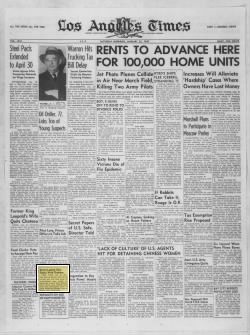
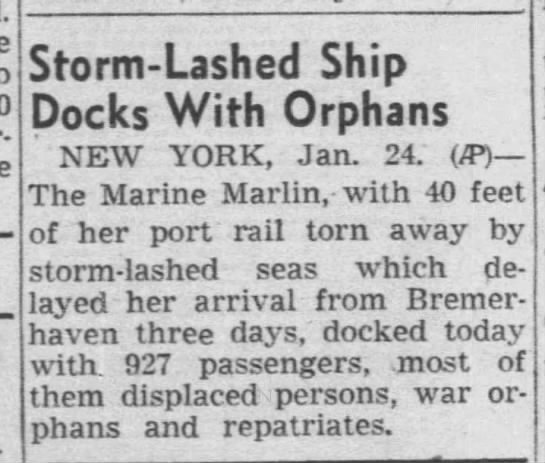
News of the ship’s arrival, as reported in the Los Angeles Times, 25 Jan 1947.
Following are additional excerpts from Werner’s journal:
“Today, as I am writing these notes, we have been on our journey for ten days. And not one of those days has been calm, with the exception of the first few hours on the Channel. You always have to progress hand over hand through the hallways and up the steps, and sometimes you have to even wait until the ship has moved back up into an upright position, so that you can have solid ground beneath your feet. Yesterday, [the heavy seas] prevented us from eating on deck, and they were unable to serve lunch. Since many dishes had been broken due to the heavy seas, they ended up serving some goulash with no sides on tiny paper plates. The kitchen was unable to really cook anything. Even the bread – I was able to talk to the ship baker – fell out of the oven. Due to the bad weather our trip will be delayed by at least five days! And the weather is also not very likely to change any time soon. As I went to send off a radiogram to New York City, I happened to talk to one of the ship officers. I learned from talking to him that the bad weather is dominating an area of at least two thousand square miles. We have changed course frequently in order to enter areas with better conditions, to no avail. It is the same everywhere. So, we can anticipate a continued roller coaster ride until the end of our trip. The officer said that January through March tended to be the worst months of the year for travel. When I go down to our sleeping rooms, it looks like after an alarm. All suitcases lay wildly scattered around between broken piece of glass and bottles. The dining room chairs are falling over like tin soldiers, and it has even happened that some passengers have sustained injuries, and somebody even fractured a bone. All of us are doing fine, thanks to god.
“It was horrendous, the absolutely worst time to cross the Atlantic. We, the passengers out of a hellish time were thrilled to be chosen all the same. As a small child, literally, just 7yrs. I remember the ship pitching and rolling, making it extremely difficult to avoid being thrown around. The stormy seas, crashing waves across the deck and top of the ship were frightening. I either recall or was told that life boats were to be readied. Long tables and benches were the way I recalled the Dining Area. Very few overcame extreme seasickness during the long harshest portion of the voyage. My Dad, like your grandfather endured severe food deprivation. Somehow his overwhelming need for fats led him to eat butter with a spoon, turning the few remaining diner’s stomachs to rebel. My Mom, Lilly, was seasick. She and I were in the woman’s area, sleeping on stacked cots perhaps 3 high. She, took the top bunk so I wouldn’t be thrown out by the motion of the wild sea. She did, resulting in a severe head injury that almost cost her a chance to enter the US during our evaluation on Ellis Island.”
Helga Bonitz
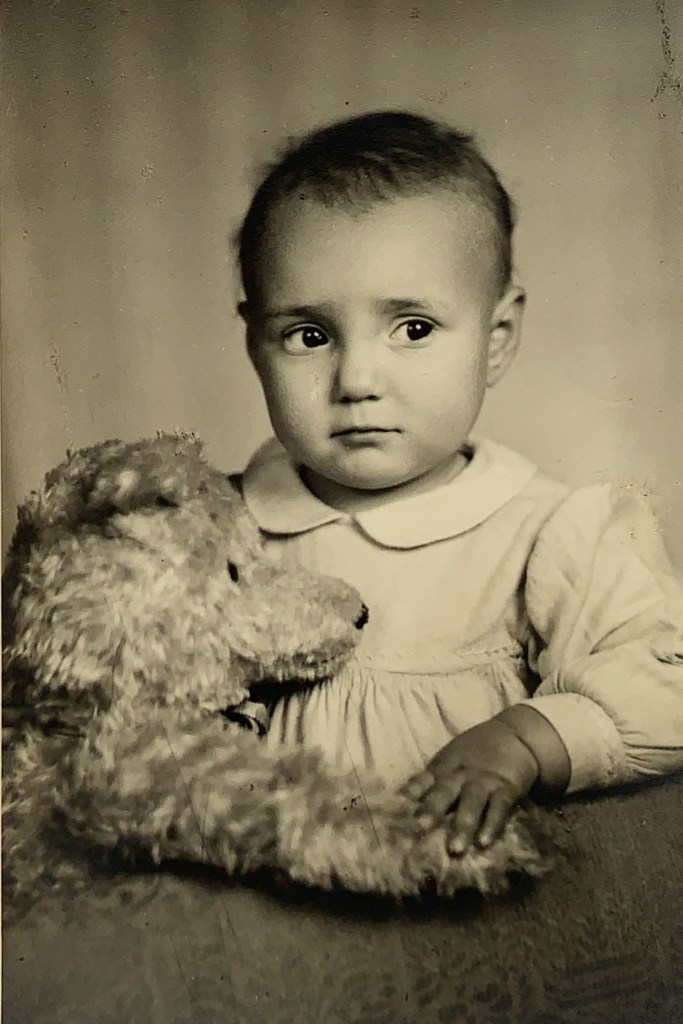
Werner continued, “Rosemarie gets really upset every time that people have to hold on tight to tables and chairs until finally everyone is tumbling around any way. So most of the times she stays in her cabin on her bed. By the way, yesterday our crib broke because it was thrown back and forth so heavily. We moved the crib outside, so we could have more space in the cabin. Already in Bremen Madi complained about her ‘Baumi’, her left thumb. It was swollen pretty badly, all red, and it looked pretty bad. We’d hoped that it would get better soon. Unfortunately, it was getting so bad that she had to go to the ship hospital once we were on board. Her thumb was badly infected, discharging pus, and she was also developing a high fever. We were afraid that she might have come down with the measles since her entire body was so red. After the doctor cut and drained the wound and after she saw the doctor on a daily basis to inspect the wound and change the bandage, her fever went down. Yesterday, they removed her bandage and her ‘Baumi is Heile Heile [Editor: This is an idiomatic German saying, perhaps similar to the English saying, ‘Let Mamie kiss my owie—make it feel better’]. This episode was a pretty scary warning shot for us. The doctor, a lovely man, treated her really well, and she made friends with him. Every time she sees him even from a distance, she calls him. Sadly, he doesn’t understand a single word of German, so the conversation is always a little funny.
“The quality of food served on board has gotten much worse, and the food is absolutely monotonous. Almost every day, we are getting exactly the same food, and it’s often not very good at all. We hardly receive any fruit because the stewards are distributing it under the table among those that are on good terms with them, for example the so-called ‘pretty girls.’ In the evenings after supper, you can see those girls standing at almost every corner of the ship, eating ice cream, fruit, or even a good piece of meat (the latter of which we were served rarely). Beverages or something along those lines are not available at all. It is only in the evening hours between 7 and 8 p.m. that they offer Coca-Cola, cigarettes and chocolate at a small kiosk, however, most everything sells out quickly with the exception of cigarettes, and you have to endure getting pushed around by crowds of people if you want to get anything at all. In addition, some parts of the ship are so indescribably filthy, let alone the hard-to-ignore signs of sea sickness everywhere around us. Fortunately, our bathrooms were relatively clean – since we slept on the “C” deck – however, it almost requires special skills to use them, considering the ship’s constant motion.”
Finally, after fourteen days, the Marine Marlin arrived in New York City. Werner continued, “You can imagine the level of excitement among passengers, when the ship radio announced that we were slated to arrive in New York City (Pier 90) on January 24, probably around 3 p.m.! I almost want to say that from that point on nobody was experiencing sea sickness any more, and one could notice a sudden onset of bustling activity. Everyone started to pack, and I hardly recognized many peoples’ faces because they had decided to finally shave their beards. On the next day, in the morning of the 24th, we were supposed to be able to see land! Fortunately, the storm finally calmed down, which was probably due to the fact that we were getting closer to main land, plus we were moving through much calmer waters, with the ship leisurely bobbing up and down. Almost no one slept much this night, considering the state of pleasant anticipation for what was to come on the next day, which was going to be our very last day on this shaky platform! And right on—shortly after breakfast, which was worse than ever before, we spotted a big steam boat along with several smaller fishing boats, and most of all we were seeing land—which we had been longing to see for such a long time! The SS Marine Merlin was full of bustling activity, and the ship radio continuously made announcements related to logistics of the anticipated arrival. The young ladies – who had almost ‘died’ from sea sickness a few days prior –were now seen strolling around the decks dressed up in new and pretty dresses, as if they were already perfect Americans!”
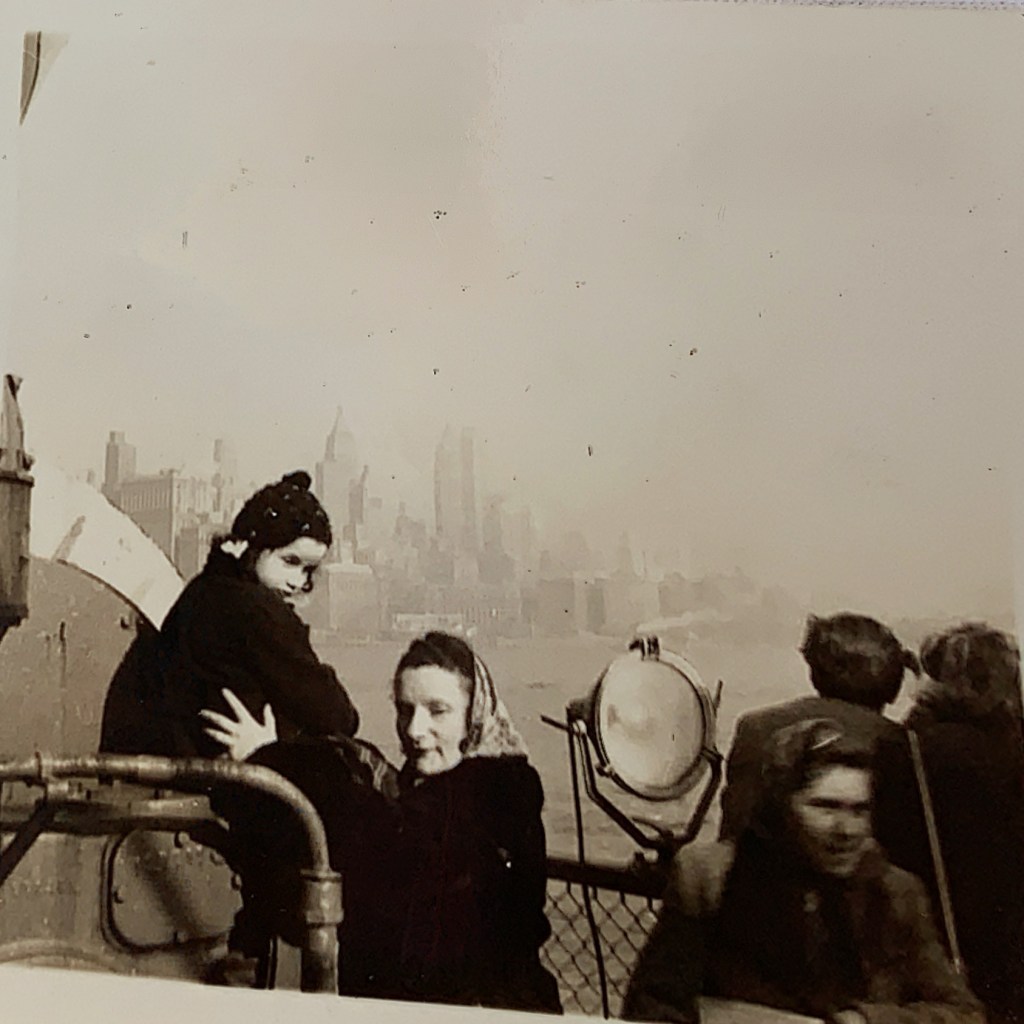
“Like millions of other immigrants to America, I experienced the elation of seeing the Statue of Liberty looming up at the entrance of New York Harbor. After the stormy crossing of the Atlantic the skies cleared as if by magic. The ship floated over the smooth surface of a suddenly tranquil sea. It seemed as if the elements themselves became subdued by the torch lifted high, promising freedom to the oppressed masses of humanity. For me and my fellow survivors the words of Emma Lazarus — carved on the pedestal of the Statue of Liberty — were especially appropriate. Our ship indeed carried the “huddled masses yearning to breathe free.” I experienced the exultation and emotions of joy as we disembarked in Ellis Island, the gateway for millions of immigrants to America. My sufferings came to an end. The promise of the New World, at one time unattainably distant, now became a reality.”
Fellow passenger, name not recorded.
“At around noon members of the much-feared commission came on board, in order to check our paperwork and prepare us for arrival. We had been moving down the Hudson Bay for quite some time and were seeing the shore on both sides of the boat. We saw many boats—large and small— that were either moving or staying still. And wherever we looked, we saw much bustling activity and movement, a scenery which we were not used to seeing at all. By 1 p.m. we were supposed to have passed the commission’s controls, at which point we received the relevant paperwork and stamped ID cards, which were needed to get off the boat. At this point we were able to see the first sky scrapers! We passed the first couple of piers of the Manhattan peninsula, which is of course where the sky scrapers are located. However, we didn’t get to see much of it since we were tied up with processing our paperwork for about 30 minutes. Since we were among the first to go through processing, however, we were able to get back to our deck pretty quickly, to catch an impressive panoramic view of this big city. As part of the processing protocol, we received a visa as well as a landing card. Additionally, everyone received a badge that featured the name of his/her specific committee on it. Of course, we took Mädi with us to enjoy the panoramic view on deck, to take a good look all around us. All of this was so overwhelming that it is hard to describe.”
After disembarking, the Bollmanns were greeted by Lilo’s childhood friend Hilde Pinkus, who expressed relief because there had been several SOS calls from the ship during the storm. They stayed in New York City for a few days, touring the city and visiting Hilde and Lilo’s aunt Bertha Chaskel. Their voyage complete, but their journey still to continue. They would continue their travels to Cincinnati, Ohio, which would become their new home.
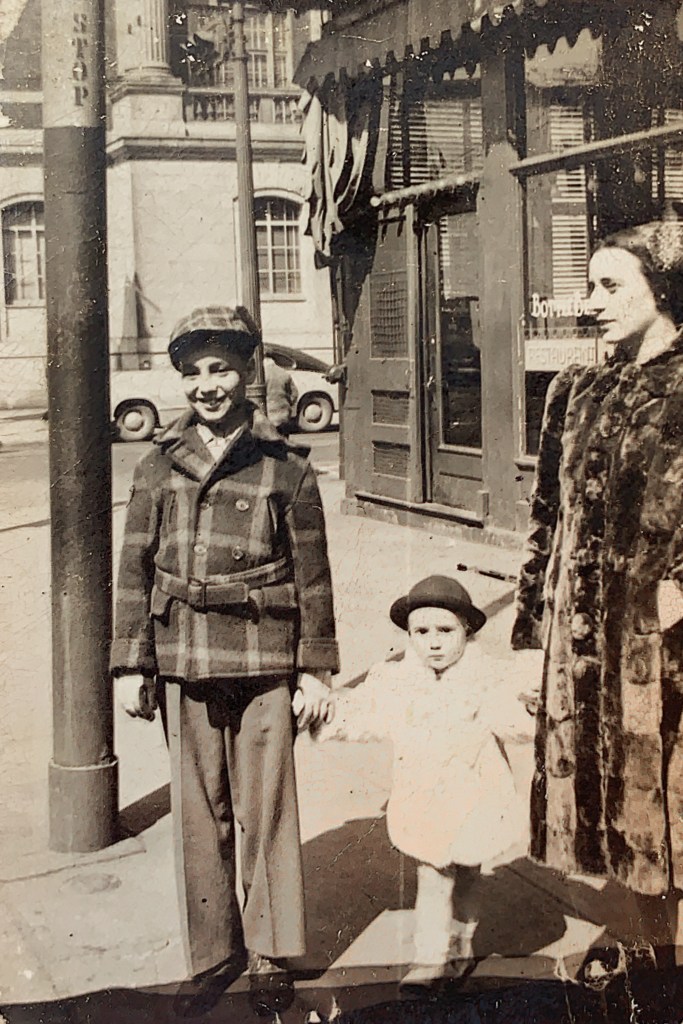
New York City 1947
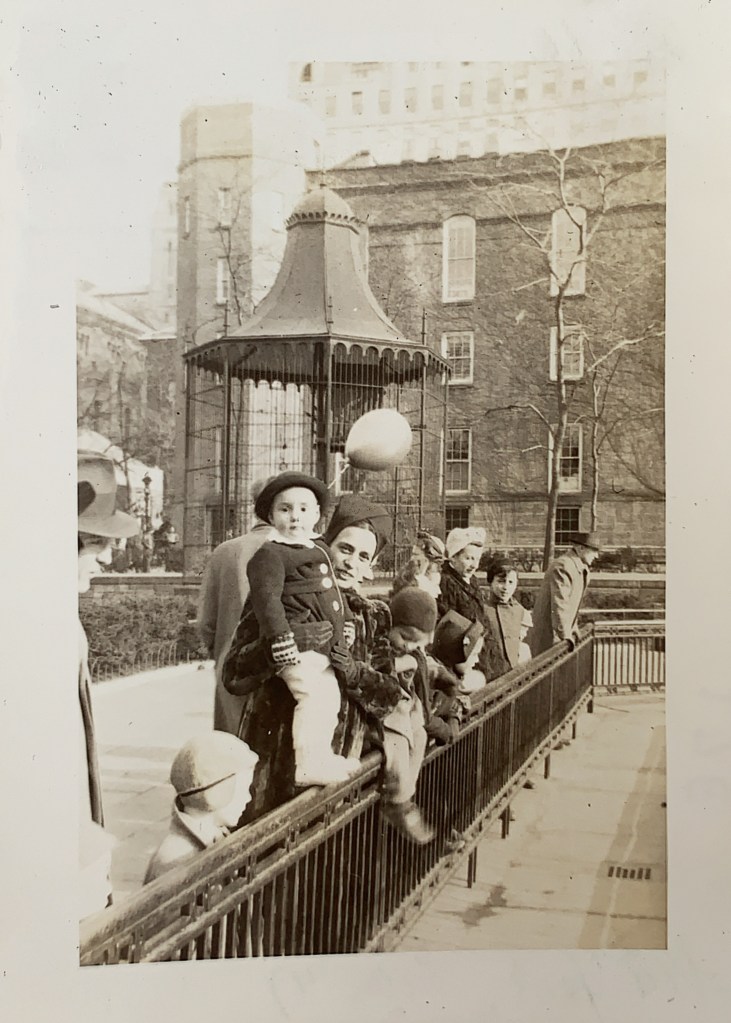
New York City 1947
Many thanks to my colleague Daniel Sturm, for his translations of Werner’s journal.
Sources
As told by Helga (Jackie) Bonitz Zucker to Dorene Nowatzke, March 8, 2020.
Daily News, New York, New York, January 25, 1947, accessed via www.Newspapers.com on March 29, 2020.
Family history as told by Heinz (Henry) Bollmann.
Family history as told by Rosemarie (Rosemary) Bollmann Church.
Journal of Werner Bollmann, family collection.
“Leonard Lyons,” Dayton Daily News, Dayton, Ohio, accessed via www.Newspapers.com on March 29, 2020.
“Memorandum from Mr. Levine to Mr. Leavitt, Subject: Marine Marlin”, September 23, 1946, JDC Archives, www.archives.jdc.org, accessed March 29, 2020.
New York Passenger Lists 1820-1957, Online publication – Provo, UT, USA: Ancestry.com Operations, Inc., 2010.Original data – Passenger Lists of Vessels Arriving at New York, New York, 1820-1897; (National Archives Microfilm Publication M237, 675 rolls); Records of the U.S. Customs Service, www.ancestry.com.
Secrets in the Suitcase: Stories My Mother Never Told Me, Molly Greenberg, accessed via GoogleBooks on March 29, 2020.
Slavs: Victims of the Holocaust, www.Prezi.com, accessed March 29, 2020.
SS Marine Marlin, Jesse Russell and Ronald Cohn, Book on Demand, 2012, accessed via GoogleBooks on April 12, 2020.
“Storm-Lashed Ship Docks with Orphans,” The Los Angeles Times, January 25, 1947, accessed via www.Newspapers.com on March 29, 2020.
 The Budding Genealogist
One thought on “Coming to America, Part II”