
On the night of 9 Jan 1947, the Bollmann family packed their bags. They were leaving Germany the next day, emigrating to the United States to begin a new life.
The past 10 years had been a full range of emotions, always punctuated by fear. Werner and Lilo were married just one year before the Nuremberg Laws went into effect, which, if they had waited, would have prohibited Werner, a Christian, from marrying Lilo, a Jew. Times of happiness, such as the birth of their first child Heinz, were bookended by times of fear, as when they sent him to live with his Christian grandmother in Braunfels. A set of twins was lost when Lilo was imprisoned for not carrying the proper identification papers with her. Werner had been arrested by the Gestapo for not divorcing his Jewish wife and sent to a labor camp, from which he had escaped shortly before the end of the war. Lilo’s mother died from malnutrition and lack of medication, and her father perished in a concentration camp.
By 1946, life in post-war Berlin was improving, but slowly. Their daughter Rosemarie, who was born while Werner was in camp, was two years old and growing rapidly (thanks in part to her penchant for chewing ration cards). Heinz hustled potatoes from Allied soldiers, especially one named Robert who befriended the cute 11 year old. Werner had established a reclamation business with his brother Fritz, salvaging rail ties and reselling to the government. But 1946 Berlin wasn’t the same as early 1930’s Berlin, which saddened them, especially Lilo. It was time for a fresh start.

Lilo was insistent, a characteristic trait observed by all who knew her. This wasn’t her same home. America was the land of equality and opportunity. Werner, ever the peacemaker, began to agree.
Immigrants to America were required to be sponsored either by a friend or family member, or a sponsoring agency. The family found sponsorship through the American Christian Committee for Refugees, which provided resources for families of Jewish and Christian beliefs.
With heirloom belongings and other household items in storage, the Bollmanns arrived at a displaced persons camp in Bremen in early January 1947. By now, Heinz was 12, still cute, but a shy boy. He recalls attending a dance with his parents one evening, but sitting in a corner by himself. Another couple found him and assumed that since he was by himself, he must have been an orphan. They soon began discussing how they could adopt him when Werner and Lilo arrived to clarify the confusion.

Helga Bonitz was staying at the same camp with her family. Her father, Willy, had been interred in the same camp with Werner, also for not divorcing his Jewish wife Lilly. The Bonitz family arrived at the camp a couple of weeks earlier, and Helga remembers participating in a Christmas play.
The Marine Marlin was ready for boarding on 10 Jan 1947. The ship was originally built for troop transport use during World War II, then retrofitted for passenger class after the war. As part of President Truman’s commitment to refugee aid, the ship was part of a fleet owned by US Shiplines to provide refugee transport from Europe to the United States.
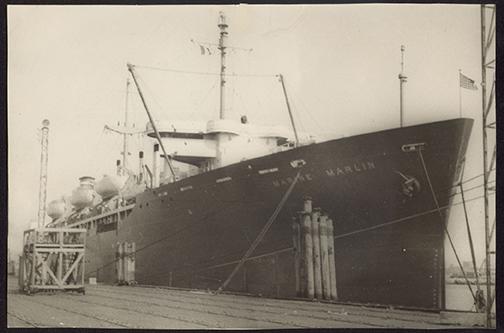
According to testimonies, the ship was able to hold just over 900 passengers, with men bunked in barracks style quarters on the most lower levels, and women and children living in upper level state rooms when possible. Mr. Levine (first name unknown) described conditions on a September 1946 voyage as follows:
“…this ship was overcrowded. It carried a total of 940 passengers…Almost all of our people had to sleep in dormitory type rooms in the hold of the ship. The ventilation was bad and many of the people could not sleep at night. Many of the rooms had no outside port hole. During most of the trip the ship was dirty. People complained that the rooms were seldom cleaned. For two days the sun deck was not washed and the garbage pails were overflowing with orange peels and papers all over the deck…There were about ten deck chairs for the 900 odd passengers. The people crowded on the sun deck from morning until late at night…There were no recreational supplies of any kind, except the small quantity of reading matter which the Joint supplied. Most of our people ate in the Cafeteria and many complained that the service was pretty bad. Arrangements were made for a small group to have a kosher kitchen and space was provided for them to conduct religious services…”
Letter from Mr. Levine to Mr. Leavitt, American Jewish Joint Distribution Committee, September 1946.
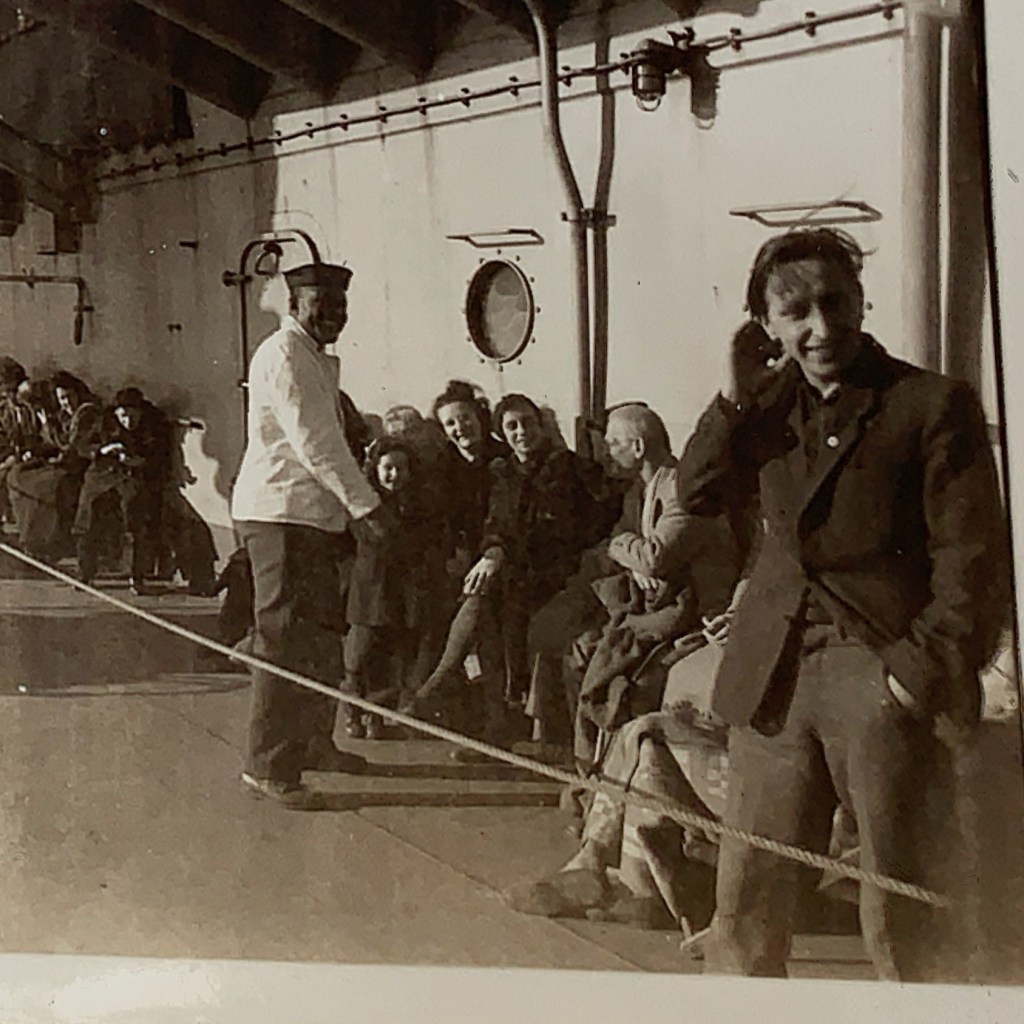
Spartan though the conditions may have been and braving the January cold, spirits must have been high that day for the 927 passengers as they embarked onto the ship. They were leaving war, loss of family, friends and property, and travelling to the Land of Opportunity. One passenger wrote, “We travelled on an old warship named Marine Marlin. The first day of our journey was a very happy one. We were leaving behind all our grief and sorrow. We were on our way to a new, great country, where we hoped to find a new, happy life.”
 The Budding Genealogist